Showing posts with label #ww2lovestories. Show all posts

Friday, July 23, 2021

LOVE AND LAUGHTER . . . AND PEACE EVER AFTER by Eleri Grace


Slit Trench, Northern Burma, 1944
The heroines of my novels, the Red Cross Girls, always held out hope for an end to the war and the elusive dream from the Vera Lynn song -- "there'll be love and laughter . . .  and peace ever after." Through their overseas service, they had seen so much death and pain and loss that they fervently wanted the war to end. The Red Cross Girls were often stationed as close to the front lines as the combat nurses, and even the "safe" posts were often on air bases where the women witnessed casualties virtually every day. It was not uncommon for a woman to dance with a pilot or crewman one night and learn the next day that he had been killed on a mission or in an accident the following morning. Death -- and the harsh realities of war --- hovered over every aspect of their service. It was emotionally draining and stressful work, thus prompting the Red Cross to transfer the women frequently (with the often futile hope that short duration assignments would minimize their emotional attachments). 

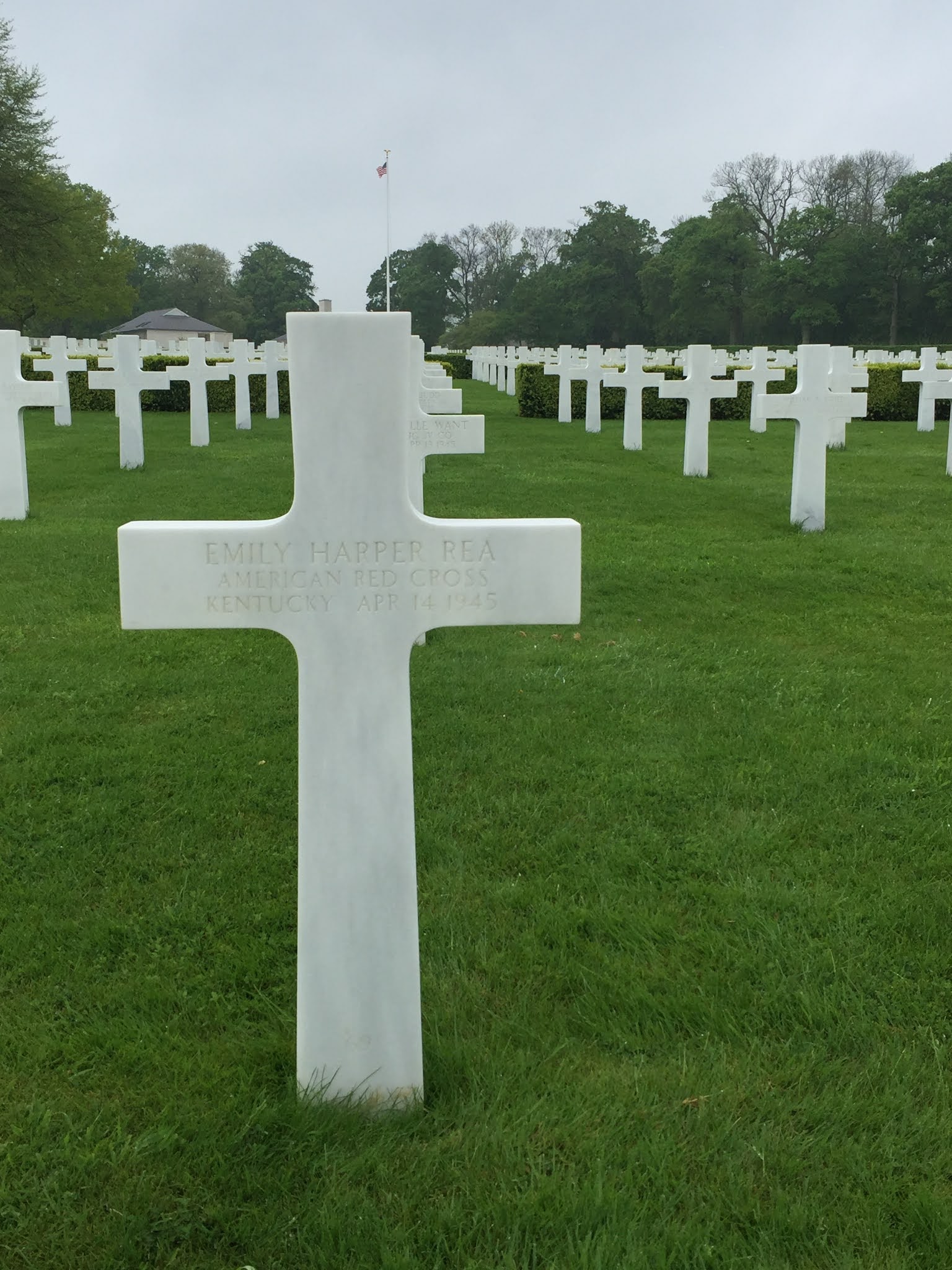
Emily Harper Rea, ARC, April 1945
The women worried about their own loved ones (husbands, sweethearts, and brothers), and they cared deeply for the men they served through the Red Cross recreation clubs and Clubmobiles -- the "boys" to use their parlance of the time. But they too were not immune from the dangers and vagaries of war -- some 53 ARC personnel (mostly women) lost their lives in WW2 service. These deaths most often occurred as a result of plane crashes (these independent and spirited women often flouted the ARC's prohibition against the common practice of "hitching a ride" with a friendly pilot), but at least one woman died as a direct result of enemy action. 


France, Memorial Day 1945
All dreamed of peace and an end to the war -- long-awaited reunions with a husband or sweetheart or marriage to a wartime suitor or just a return home to American food, family, and traditions. But at the same time, the Red Cross Girls recognized that they too were as changed by their wartime service as the soldiers. An unnamed Red Cross Girl correspondent wrote back home: "None of us [will ever be quite the same again] -- GI or Red Cross." She noted in the same letter that she and her friends were "terribly calloused and never calloused enough," that they "were disciplined and worn down smooth, so that you smile when you're dying." They worried about how they would readjust to civilian life and how they would cope with the trauma they had seen and experienced during the war years. The concept of PTSD was decades away, and while folks back home might be reasonably sympathetic to a man returning home with a bit of "combat fatigue," they likely couldn't grasp the emotional scars and residual stress the Red Cross Girls brought home.

Camouflaging Clubmobile, Normandy 1944
These intrepid and daring women were also uncertain if a slower-paced existence in peace time America would suit them -- they had spent years being "on" all the time time, and most importantly, having far more freedom and discretion than they could expect when they returned home. Indeed, the women wondered how they would cope with returning home to an America where they were expected to now settle down into domesticity. The unnamed correspondent had noted in her letter that while most of the soldiers thought them brave, others believed that the Red Cross Girls belonged "back home where a woman's place used to be . . . about 200 years ago." I find that quote so very intriguing -- this woman, writing in 1944, believed that the idealized American version of housewife and stay-at-home mom was already outdated. Though it would be difficult to prove, I have a strong sense that the daughters of the Red Cross Girls, nurses and WACs, as well as all the women who undertook crucial wartime work at home, led the charge for the equality movement and second wave of feminism in the 1960s. 

Lunch break, field duty, Normandy 1944

Their post-war lives varied, but all the Red Cross Girls who left memoirs, gave oral history interviews, or otherwise reflected on their service during the war sounded a similar note: the war years were the most significant time in their entire lives. One man recounted in a recent blog that his mother made it a tradition throughout his childhood that they would put up a small tabletop Christmas tree decorated with simple handmade decorations. He recalled too that she nestled photographs from the war amidst the branches of this small tree. At the time, he didn't understand why she bothered with this simple tree when they had a larger and more lavishly decorated tree in the living room. It was many years later before his father explained that this was his mother's tribute to her "boys," the men she had known through her years as a Red Cross Girl. The little tabletop tree with simple decorations was exactly like the one she and her fellow Clubmobile crew mates put up in a small makeshift recreation club in Belgium during the cold winter of 1944 at the height of the Battle of the Bulge. I feel certain there were probably other little tabletop trees and other ways the women honored the memory of their meaningful service. 

White banner is a German surrender flag - Patton's Third Army had cleared this town days earlier and the attached Clubmobile crews moved into this hotel

Time and again, just as male WW2 veterans so often do, the women who served overseas identified those years as the ones that left the deepest mark and changed them the most profoundly. The women endured stress, anxiety, trauma, and grief -- but they also experienced adventure, independence, freedom, friendship, camaraderie, and yes, romance and love. Peace allowed them to return home, but I suspect finding true "peace ever after" was a challenge for many of these women. 

Monday, April 12, 2021

Laugh in the Face of Danger by Eleri Grace

 I was a little stumped by this month's prompt for a bit. I love novels that can inspire a range of emotions in a reader, including side-splitting laughter, but I would probably have a hard time hitting that humorous tone even if I weren't writing in the WW2 genre. Yet, while many of my favorite authors who write humor very effectively include romance authors Kristan Higgins, Tracy Brogan, and Josie Silver, one of the funniest books I've ever read was the improbably humorous WW2 classic, Catch 22 by Joseph Heller. 


Of course, many would deem it dark humor. But Heller's mastery of satire is unparalleled. Though many of the compiled "funniest lines" you might see online are humorous on their own, context adds immeasurably. So I do highly recommend reading the entire novel to get the full effect of Heller's genius. 


“You have a morbid aversion to dying. You probably resent the fact that you're at war and might get your head blown off any second."

"I more than resent it, sir. I'm absolutely incensed."

"You have deep-seated survival anxieties. And you don't like bigots, bullies, snobs, or hypocrites. Subconsciously there are many people you hate."

"Consciously, sir, consciously," Yossarian corrected in an effort to help. "I hate them consciously."

"You're antagonistic to the idea of being robbed, exploited, degraded, humiliated, or deceived. Misery depresses you. Ignorance depresses you. Persecution depresses you. Violence depresses you. Corruption depresses you. You know, it wouldn't surprise me if you're a manic-depressive!"

"Yes, sir. Perhaps I am."

"Don't try to deny it."

"I'm not denying it, sir," said Yossarian, pleased with the miraculous rapport that finally existed between them. "I agree with all you've said.”

Catch 22, Joseph Heller 

I am in the midst of writing my third Clubmobile Girls novel, set in India and Burma, and my hero will find himself recruited into dangerous search-and-rescue work in the Burma jungles. I've found a memoir titled "Hell is So Green" by William Diebold to be particularly helpful in my quest to provide my hero with plenty of challenges. Diebold jumped into the jungles and mountains of Burma a number of times to help lead downed airmen back to an American base --- a serious business. Yet, his memoir crackles with dry and self-deprecating wit, and consistently humorous exchanges with the pilots who maintained communication with him after his jumps and during his treks through dangerous countryside. In this instance, Diebold's parachute hung up in a tree, and a native boy helped cut the lines so he could reach the ground. When he made it back to the supplies the pilot had dropped, Diebold got on the radio: "Just once, old man, just once I wish one of you jokers would drop me on the ground. I've been in trees so much lately I feel like a bird." 

Humor can be found in the darkest and lowest of times, and yes, as Lion King's Simba confidently declared, in the face of danger. As we navigate our way back to more normalcy in the coming months, I hope you all find more and more occasion for laughter and humor. 


You can learn more about me on my website or follow me on my social media accounts at Facebook, Twitter, Instagram, and Pinterest

You can find my Clubmobile Girls novels on Amazon