Showing posts with label change. Show all posts

Monday, January 10, 2022

Everything Old is New Again!

By: Marcia King-Gamble

www.lovemarcia.com

Happy 2022! I can’t help but wonder where the years went to? Just 24 years ago, I signed my first book contract with Kensington Publishing. Memory fades as to whether it was a two- or three-year contract, but I do know it was for multiple books and that trend continued for many years. Even today, I still remember that feeling of elation when I got that very first call from an editor. Months of visualization had actually paid off.

My very first published book. The cover has since changed and so has the title.  You can find the updated version here: https://amzn.to/3FbjcT1

Back then I used to go to stores like Walden’s (now out of business), Barnes and Noble, and Borders (also out of business,) and imagine my books being on that prime shelf space. I could see, smell, and feel that print book. I also didn’t realize that shelf space is paid for by the publishing house and positioning is everything. That eye-opening information came later.

Although Indie books were around for ages, the authors were seldom respected. However, with the advent of the Kindle, the Indie Market took off and traditionally published authors slowly migrated over.

This was for many reasons. Some wanted complete control of their business, others were dropped by their publishers, and others came out of pure curiosity. Mid-listers were more willing to take a chance on this market, and after witnessing the success of some established authors, the New York Times and USA Bestsellers made their way over.

Of course, there were always naysayers. It wouldn’t last, some said, no one reads substandard books. It’s a market for those who can’t write. The list went on. Change can be hard for both the reader and author. Change is hard for most people, anyway. But regardless, it looks like the Indie Market is here to stay, and many talented authors have released some very fine work.

For me, after careful reflection, I’ve decided to return to world of traditional publishing, although this is not necessarily an exclusive move. While there are certainly pluses to the Indie World, there are negatives to. There’s something about the freedom to write what you want, when you want, but I need the structure and discipline of a defined delivery time.

As an Indie it’s easy to procrastinate. We have no pressure to deliver on any date, regardless of whether said date was published on social media. A handful of fans might reach out inquiring as to where your book is, but you don’t have a cover artist or editor breathing down your neck because you’re holding up someone elses's release. If you don’t deliver, there is no fear of losing your slot and having your release delayed another year.

Being Traditionally published means putting your butt in a chair and getting the writing done. It means delivering on time and working with an editor that requires you to get edits back to her and at a specified time.

I'm not saying being an Indie writer  hasn’t been a nice run, and I wouldn’t continue to write for the market, but I miss the worldwide distribution possibilities, and I miss working with editors who have my back.  So, my plan is to come back as a hybrid. This way I get the best of both worlds.

More from my backlist. 

About Marcia King-Gamble

USA bestselling romance writer, Marcia King-Gamble originally hails from a sunny Caribbean Island where the sky and ocean are the same mesmerizing shade of blue. This former travel industry executive has spent most of life in the United States. A National Bestselling author, Marcia has penned over thirty-four books and eight novellas. She has contributed to Michael Fiore’s DigitalRomanceInc and served as a moderator on the now defunct eHarmony advice boards. Having witnessed the bad, the ugly, and the not so good in relationships, she still prefers to write about happily ever after. Caring for her animal family keeps her grounded and sane.

Visit Marcia at www.lovemarcia.com or “friend” her on Facebook: http://bit.ly/1MlnrIS

Be sure to join her newsletter mailing list.

Instagram * Amazon * Website * Facebook * Twitter


Monday, September 27, 2021

Is Change Good or Bad?

 By Courtney Pierce

I’m always amazed by people who forge kindergarten friendships that last into retirement. Kids who grow up together share all those important rites of passage: first kisses, proms, graduations, first cars, marriage, kids, careers, upsizing, and finally downsizing. Life-long relationships provide a buffer of comradery to weather the emotional effects of change.

I had a different experience. 

Change was my friend. Every four or five years, our family moved to a different state in order to support my father’s career. I didn’t progress through elementary, junior high, and high school with the same set of friends. In fact, my family moved from New Jersey to California at the conclusion of my junior year. I didn’t even flinch about spending my senior year in a new high school located over three thousand miles away. I was excited about it.

There were upsides to all my early life changes. Every move allowed me to reinvent myself. The "new me” became quite comfortable with going in cold to meet people. After all, no change would last forever and held no long-term risk. My new friends had no pre-conceived notions about who I was. They never saw me in my kid years with goofy pigtails, zits, white go-go boots, or bad sixties hippie fashion.

My long career in the Broadway entertainment industry fanned the flame of change. Every two or three years, the company would go through a restructure, a merger, or an acquisition. New responsibilities, new people, new processes, and a new title graced the freshly printed stationery and business cards. I was transferred to Minneapolis for four years, and then transferred to Houston. Wow! I felt like a polar bear in a hot tub after that move. I welcomed all of it with open arms, but many of the staff had emotional difficulties with the transitions. Some people's comfort zones require everything to remain predictable and routine.

So much change had a downside too. Forging long-term friendships became quite difficult. I would engage people with limited access to the layers of me. Going deeper required an investment in longevity. Hence, I was equally comfortable being a loner or part of a group—two different sides. And when it came time to move again, the physical and emotional distance dissipated ties over time.

The protective bubble I’d perfected is now coming in handy, or maybe backfiring as the case may be. My husband and I are old enough now to be losing people from our lives, not emotionally but physically. Our elder family members are all in their eighties and nineties. Being from a small town, my husband is one of those with life-long friends, a few recently lost or battling illness. Just this past week, I lost my aunt at the age of 88. My uncle at 93 is in the process of giving up. The dominoes of change are falling in a different direction. How will it feel for us baby boomers to become orphans? Jeff and I long ago lost our fathers, but the tethers remain tight to our mothers. We both get a bit jumpy when the phone rings late at night.

The only thing we can control is our state of mind. No better example of this is the recent transformation of my Mom (the great fictional Ellen Dushane of the The Dushane Sisters Trilogy) at the ripe age of 87. After a six month wait, she got a new start when flew to Oregon to help her acquire a companion--a Maine Coon kitten. 

This kitten, named Sally, has rendered my Mom twenty years younger. She laughs endlessly about Sally’s antics and no longer complains about the lack of geriatric healthcare (she’s right about that!). Mom’s aches, pains, and complaints have magically disappeared. I think it’s because she’s getting to be a Mom again, even if it’s to mother a kitten who's tearing her pristine house apart. My heart soars at the lilt in her voice.

I'm convinced that emotions play a major role in our physical health.

Now that my husband and I are settled in for our retirement in Montana, I need to recalibrate my thirst for change. I'm done with relocating. Now I have a long list of house projects: writing, the garden, landscaping, new inside paint, and divesting of “stuff” for others to appreciate. How many flower vases does one really need? I must have fifteen and use only the same three.

While I work through my to-do list, a new book is emerging. Current world events have allowed me to incorporate deeper spiritual meaning into Big Sky Talk. The real-life battle of good versus evil is taking place throughout the world, and the outcome by year's end will affect stories for the next hundred years. Massive changes are in store for our planet, which will inspire us to look back at history with new eyes. Who knew all those ground-breaking sci-fi, fantasy, and espionage movies over the past fifty years held so much truth?

It's time to re-watch a few classics with fresh popcorn: Contact, Close Encounters of the Third Kind, Signs, The Matrix, Lord of the Rings, Conspiracy Theory, and Independence Day. Oh . . . we can't forget The Manchurian CandidateSoylent Green, Fahrenheit 451, The Day the Earth Stood Still, and Invasion of the Body Snatchers. Hmmm...in War of the Worlds, our natural human immunity becomes the greatest weapon against the Martian invaders. H.G. Wells first serialized that story in 1897. What did he know that we didn't?

If that's not enough change for a junkie like me, then I can always tootle down to the bank and turn in our giant Tupperware tub of change.

Co
urtney Pierce is a fiction writer living in Kalispell, Montana with her husband and stepdaughter. She writes for the baby boomer audience. She spent 28 years as an executive in the entertainment industry and used her time in a theater seat to create stories that are filled with heart, humor, and mystery. She studied craft and storytelling at the Attic Institute and has completed the Hawthorne Fellows Program for writing and publishing. Active in the writing community, Courtney is a board member of the Northwest Independent Writers Association and on the Advisory Council of the Independent Publishing Resource Center. She is a member of Willamette Writers, Pacific Northwest Writers Association, and Authors of the Flathead. The Executrix received the Library Journal Self-E recommendation seal.

Print and E-books are available through most major online retailers, including Amazon.com.
Check out all of Courtney's books: 


New York Times best-selling author Karen Karbo says, "Courtney Pierce spins a madcap tale of family grudges, sisterly love, unexpected romance, mysterious mobsters and dog love. Reading Indigo Lake is like drinking champagne with a chaser of Mountain Dew. Pure Delight."

Coming in 2022!

When Aubrey Cenderon moves to Montana after the death of her father, the peace and quiet of Big Sky Country becomes complicated with a knock on the door from the sheriff. An injured grizzly bear is on the loose and it must be eliminated before it kills again. The sheriff's insistence that she buy a gun for protection will present Aubrey with some serious soul-searching, because the grizzly-on-the-run is hunting her too . . . for a different reason.


Wednesday, September 22, 2021

Thriving on Change

As an air force brat, change was constant and continuous. We moved around every few years, and I got to experience a change of scenery from my bedroom window, and a revolving door of schools and friends. The one constant in my life (besides my parents) was my older brother.

Me and my Brother
We didn't know what it was like to be settled, and if we stayed in one place for too long, we became unsettled by being so settled. 

I had the fear of missing out, before FOMO was even a thing.

I abhorred the mundane. I wanted excitement. I wanted new. I wanted that feeling of trepidation you get from venturing into the unknown.

As I approached adulthood, I could have embraced security. Put down roots. Wallowed in familiarity. 

Instead, I chose the alternative.

Quotes to Live By

I've been carrying a laminated quote card around with me for over forty years... when I read it, I thought that Germaine Greer was looking into my soul.

Security is when everything is settled, when nothing can happen to you; security is the denial of life. Germaine Greer 

I've never read anything else by her—but those 18 words have been powerful enough to propel me towards the life I knew I wanted. She made it ok for me to embrace who I wanted to be. 

I've carried that quote card through the multitude of changes in my life. I've relocated to different countries, started new jobs, and I've lost count of the number of apartments and houses I've called home. 

Sometimes I forget about this quote, but then I'll find it tucked into the inside pocket of my passport holder, and it brings a wry smile to my face. It's a reminder that my transitory lifestyle fits me like a glove and I wouldn't have it any other way.

On The Move ... Again

Covid temporarily put a halt to our travel plans, but armed with a vaccine and facemark, I'm ready to embrace more changeEarlier this year we sold our house in Turkey, relocated to Los Angeles, and now we're in the process of applying for Portuguese residency. 

New life—here I come.

What inspirational quotes do you live by?


About Jay Artale


Jay Artale
 abandoned her corporate career to become a digital nomad and full-time writer. 
She’s an avid blogger, podcaster, and nonfiction author helping travel writers and travel bloggers achieve their self-publishing goals. She shares tips, advice, and inspiration to writers with an independent spirit at her website Birds of a Feather Press, and documents her travels and artistic endeavours at her blog Roving Jay. Follow her on Instagram or Facebook or Twitter.

Jay is the author of A Turbulent Mind: A Poetry Collection of a Mother's Journey with Alzheimer's.


Saturday, September 18, 2021

STILLNESS IN THE STORM by Maggie Lynch


Photo by Johannes Plenio on Unsplash

Change is such a huge topic. It is scary for some and can be transformational for others. For most people it is some combination of the two. Change is sometimes forced upon us by outside events—this pandemic is one of those. Other times we initiate change because whatever is going on in our life is not how we want it to be. In both cases, we need time to be still. Time to be cognizant of the change, evaluate its impact, and then to take steps to adapt if we can.

I am a person who is what they call an “early adopter.” Usually that phrase is used for technology changes, but it can also be applied to other change. Early adopter means that I look for the positive in the change and I’m willing to try it out and see what makes sense to me. In technology, I’ve often tried out new software before most people. I love the idea of things being made more efficient for me. In trying out software, I also often find ways to use it that was never conceived by the developer. Where the software was developed for one purpose, I find a way to use it to solve a different problem that’s been nagging at me.

I’m willing to make larger leaps in technology because I’ve seen the usefulness of starting from scratch rather than trying to “fix” old code. Technology marches forward so quickly with new invention that one must embrace the new to make the next large jump.

In a non-technological context, I try to see change as an opportunity for learning, gaining more understanding, and sometimes for personal transformation. Even when the change involves tragedy, like the death of my brother as a child or the deaths of my father and several uncles as an adult, I’ve found a way to adapt. To move from the loss to the honoring of their lives through changes in the way I live my life to reflect the best of them.

But I’ve Struggled with Change for Two Years Now

But the last two years have provided too much change—change that was built on four years previous to that where I found the world to be unrecognizable. Politics have always been divisive. I’ve lived through the 1960s and 1970s—Civil Rights, Watergate and Vietnam. Yet, it seems even more so now that the lessons of the past are forgotten.  

Photo by
Tran Toen on 
Unsplash

Floods, fires, tornadoes, hurricanes have always been a part of the news cycle and I’ve lived in parts of the country where those are to be expected. But it was never as large, as widespread, and consistently happening more often than in the past two years. Furthermore, these ongoing climate events have made me more aware of the growing economic divide between the rich, the middle-class, and the poor.

Add the pandemic and it is too much change, even for someone like me who is normally able to move through it and learn from it. It’s not that I’m unable to get out of bed. It is that I have been unable to find a way to understand, evaluate, adapt and find ways to make my life and the life of others better. Though I’ve made a promise to step forward every month for the past six months, I haven’t been able to do that. I think about it and then retreat because I feel that central truths of my belief system, around the inherent dignity and worth of every being and the general goodness in humanity, are being proven wrong. Yet, I’m not willing or able to give them up. Instead, I’ve kept going to a place of denial instead of dealing with it. I scramble to the safety of logic and technology and that keeps me from stepping again into creativity and feeling.

An Opportunity for Transformation I Hadn’t Seen

Friends I know have been sharing with me the work of another writer—someone I didn’t know existed. His name is John Roedele. He is a comedian, a prose writer, and a poet. He publishes his work on Facebook and often reads it in videos. He is very good at observing the human condition and shares his insights by providing the impact on his own life. He has become one of those points of light in my inbox.

August 28th, he posted a short prose recap of his 47 years of life and what he’s learned. There were many brief insights, but this one really spoke to me and shined a light on this particular time in my life.


We treat grief like it’s a summer storm

-as if it’s a temporary event that will

quickly pass. It won’t. Grief is a comet.

It terraforms our world.

Grief doesn’t always destroy us - but it

changes the shape of our continents.

–John Roedele

For me, the reason the past two years is so difficult is that the changes have come in such rapid succession, without breaks, that I see now we’ve been hit by multiple comets and each one is trying to “terraform” our world. I haven’t been able to absorb even one and look for lessons, nevertheless four or five or ten.

I’ve read articles and heard reporting on the extended grieving this pandemic has caused, but I didn’t accept it for myself. I now realize that is what has been happening to me. To take the terraforming metaphor into my heart, I have a way forward not by wholesale transformation but my incremental alterations. In effect, terraforming the human landscape.

I’ve been pummeled by the storms because I was filling the times of stillness with counting the seconds between the thunder and lightning. With some practice I’ve learned that, if I take time to dwell in those moments of stillness, I will see others there with me in the quiet. Others who still believe in the goodness and dignity of every person. Others who are quietly reaching out and building on that foundation of trust and common good, while at the same time engaging in terraforming the human landscape by altering those foundational elements that are hostile to living and working together while striving to thrive in peace.

Now I can return to writing and building those stories and characters where they also survive the storm and find a way thrive and love and scratch out a life of possibilities.

MAGGIE LYNCH

Bio:
Maggie Lynch is the author of 27 published books, as well as numerous short stories and non-fiction articles. Her non-fiction focuses on guiding authors to business success in their career. Her fiction spans romance, suspense, fantasy and science fiction telling stories of men and women making heroic choices one messy moment at a time. You can learn more about Maggie and her books at https://maggielynch.com   
Facebook | Twitter | Instagram | LinkedIn |


Monday, September 13, 2021

Gotta be in it to win it!

 By: Marcia King-Gamble

www.lovemarcia.com

 Remember that old Kenny Rogers song?

You've got to know when to hold 'em
Know when to fold 'em
Know when to walk away
And know when to run
You never count your money
When you're sittin' at the table
There'll be time enough for countin'
When the dealin's done

I choose to interpret Kenny’s lyrics to mean life is about making little adjustments, and at times taking a different approach.  It’s about change; the C word so many of us fear.

Why is change something we fear?  I think it’s because over the years we fall into comfortable routines, because predictability makes us think we have control of our lives.  

Routines can stifle creativity, and ultimately lead to boredom. Routines also prevents us from handling the curve balls life throws us . No wonder when all hell breaks loose some crumble and some are paralyzed. Others depend on friends and family to get them back on track.


Routines and a reluctance to change can also make for a boring lifestyle. In fact, one of the reasons many marriages fail is because things get stale.  Boredom to me is a fate worse than death, but changing things up can prevent us from falling into a rut.  Instead of looking at change as something to avoid, why not look at it as a test of resiliency and a way to keep your creative juices flowing. Change can be an opportunity for personal growth, Embrace it with flexibility and keep an open mind.

Had I not kept an open mind and adopted flexibility as a way of life, I would be not be where I am today. I’d be a totally different person with a whole different lifestyle. 

You're hearing from a woman who had an alpha male  father; a man who thought that women should have secretarial skills. It was what made us marketable.  His thinking irritated me so much I refused to learn to type, (something I still regret.  I’m a two-finger pecker.) My dad could not understand why I wanted to go away to college and incur the expense of  room and board. After all, we had a perfectly fine home.   I, on the other hand, wanted to be independent.  I wanted a change of pace from New York City, and going to a small upstate town with a Main Street would be something different.

Once I got that college degree, instead of settling into a mundane job, I became an international flight attendant, which meant I was flying off to exotic countries more often than most people take buses. That was yet another thing my father didn’t understand, though he eventually got used to my wanderlust.

Being adaptable and willing to change, allowed me to live in 5 states and enjoy all the good things any city has to offer. Over time, I've had several jobs (careers). One of these jobs even opened the door to the writing world.  Had I been averse to change, that would never have happened.

Getting out of my comfort zone, also led to a free trip to Malawi. It allowed me to meet people I never would have encountered. It exposed me to a variety of cultures, foods and experiences.   

All this to say, “If you do what you’ve always done, then you’ll get what you always gotten.”  That is not necessarily always good.

So, I challenge you to shake things up a bit and make small changes. Life is way too short for saying shoulda-coulda-woulda.

Get out there and do it!  Don't have regrets. Do it your way!

 .

Coming October 19th!


About Marcia King-Gamble

Romance writer, Marcia King-Gamble originally hails from a sunny Caribbean island where the sky and ocean are the same mesmerizing shade of blue. This former travel industry executive has spent most of life in the United States. A National Bestselling author, Marcia has penned over 34 books and 8 novellas. She has contributed to Michael Fiore’s DigitalRomanceInc and served as a moderator on the now defunct eHarmony advice boards.  Having witnessed the bad, the ugly, and the not so good in relationships, she still prefers to write about happily ever after. Caring for her animal family keeps her grounded and sane.

Visit Marcia at www.lovemarcia.com or “friend” her on Facebook: http://bit.ly/1MlnrIS

Be sure to join her newsletter mailing list.

Instagram * Amazon * Website * Facebook * Twitter


Wednesday, September 8, 2021

Distress vs Eustress


If you saw the Loki series, you swatched stress change from distress to eustress in the final minutes of episode six. The title character sat in a room, alone, copletely quiet. We watched his face, saw the thoughts runing through his head before he ererged, an entirely different person. 

It happens to real life people all the time. Contemplation in the quiet solitude of our own minds results in change. Periods of quiet contemplation have never been more important than today, because at no time in human history has humanity felt the impact of change more. 

Think about it. Generations ago, life was utterly predictable and time pretty much stood still. Generation followed generation along identical lives, their paths determined by where they were born, their gender, and who their parents were. Parents, children and grandchildren, life remained the same and highly predictable (even when it wasn’t enjoyable) day after day, from birth to death.
 

Change brings stress. That may sound awful, but remember, stress is not always a bad thing. When we consider change as a threat, it can lead to distress, when we feel the demands of our environment are too taxing. Distress defines an overwhelming feeling that impairs our ability to function.
 
But sometimes stress provides a motive to engage in action. Eustress describes positive, motivating stress that can enhance life. When we welcome change, it can be invigorating.
 
Change is natural. Eustress is a choice for dealing with the stresses associated with change.

In the 21st century, change is a daily activity and our lives are no longer defined by the circumstances of our births. Noise surrounds us, the press of news, social media,(no those two are not interchangeable), conversation. All this separates people from the moments of quiet, solitary self-contemplation that helps them channel eustress and positive actions.
 
In the old days of unchanging monotony, stories - myths, legends, fables and fairy tales - were all about plot and situations meant to entertain people. Farmer Jack could change his destiny by planting a few beans and climbing a beanstalk into the sky. Characters traversed physical plots with little or no character development.
 
As a 21st century storyteller, I feel an obligation to show my readers the changes my characters go through. I concentrate on my character’s emotional arcs, on the story. Today, it takes more to break through the noise bombarding readers. Plot, the efforts characters make to overcome a problem, entertain people. Story, a character moving through an emotional arc, both entertains people and helps teach what it means to be human.
 
That’s why my writing always begins with a character and their flaw. Before I wrote the first word of Courage (2019 from Harper Children’s) I knew T’Shawn’s fears about being emotionally hurt by his prodigal son brother was his flaw. 

T'Shawn's emotional arc involved a struggle to regain the ability to trust. He moves back and forth between distress and eustress on the pages, taking readers along with him. 

Philosophers have long said that human beings are the only living creatures that can change themselves by doing absolutely nothing, at least, outwardly. So my job was to let readers in on my heroes inner actions and thought processes.  Although young T'Shawn never actually sits alone in a room using only his brain, he fulfills my goals for him. He both entertains readers and teaches them more about themselves.

I hope I contribute to someone learning how to handle change better.


Tuesday, September 7, 2021

Jangle in the pocket...

Change – noun - coins as opposed to paper currency: a handful of loose change.

In case you’ve never visited my home and native land, or have not been exposed to our currency, here is a brief overview of the money in my coin purse, i.e. the loose change.

The coin with the smallest monetary value is the five-cent piece, also called a nickel. (We stopped using the one cent piece, the penny, in 2013.)


The “tails” side of the coin features the mighty beaver, source of wealth for fur traders and their bosses in the UK. Beaver skins were widely used in the hat and coat trade, and a secretion produced by the buck-tooth critters, castoreum, was and is used in medicine and perfume. 

On all our coins, the “heads” side displays a profile portrait of Queen Elizabeth II. 


Next in value is the ten-cent piece, the dime, with a depiction of the fabled Bluenose schooner. 


Launched in 1921 from a shipyard in my little town of Lunenburg, the vessel was used for fishing as well as racing for the coveted Fisherman’s Trophy, which it held for 17 years. The original Bluenose sank in 1946 and a replica, the Bluenose II, was launched from the same shipyard in 1963 as a culture and tourism ambassador.

For the longest time, the largest coin in size and value widely circulated (there is a 50-cent coin but it's rarely seen in use), was the 25-cent piece, the quarter. 


The “tails” side of this coin typically depicts the profile of the mighty moose, the largest species in the deer family, and the symbol that represents Canada’s native wildlife. Moose can be found in every region of the country, except for the Arctic. 

Occasionally, commemorative quarters are issued with different “tails” sides.

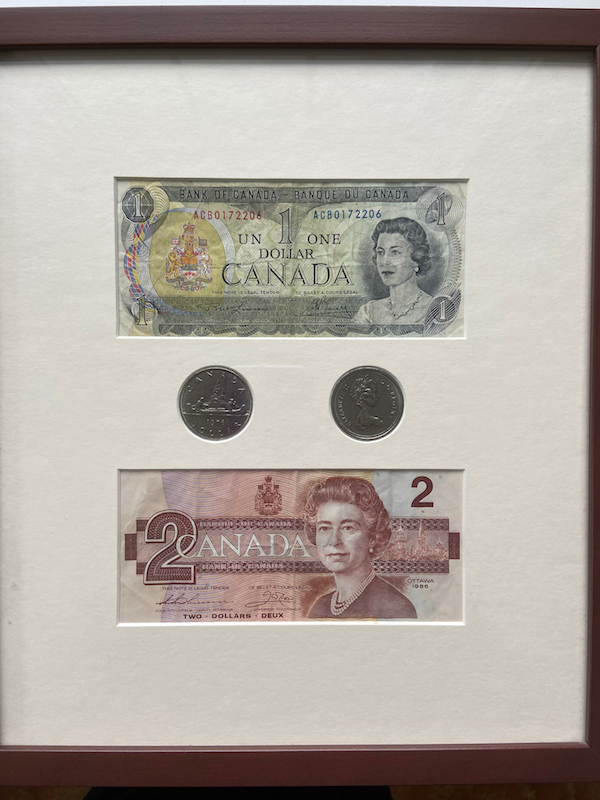
In 1987, the dollar coin, or loonie, was entered into circulation as a cost saving measure, and the paper dollar bill was taken out of circulation in 1989.


The loonie is slightly larger than the quarter. The “tails” of the eleven-sided loonie depicts a loon on a lake with an evergreen forest in the background, a scene I enjoy every summer on our camping trips to Kejimkujik National Park.

Following on the success of the loonie, the Canadian government got rid of the two-dollar bill and replaced it with the two-dollar coin called the toonie in 1996.


Slightly larger than the loonie, the two-tone coin features a polar bear designed by the artist Brent Townsend.

Here are the old paper one-dollar and two-dollar bills we had framed, just for fun.


I hope we hang on to the rest of our paper money because all those coins are heavy!

Saturday, September 4, 2021

Images of Change


...sometimes for worse...


MORE
to
less


Entropy Happens!


But sometimes for better...


Egg
to
Chicken


Desert
to
Grassland


ARE YOU???


Time for a ...


WORDS OF WISDOM:


Without Change, there can be no Growth.


Be the Change You Want to See!