

It is that time of year when I try to stop and take stock of all that has happened this year and how I’ve done with publishing. This is my 11th blog for RTG on this topic. All the things I mentioned last year are still very much in play now.
https://romancingthegenres.blogspot.com/2022/12/whats-new-in-publishing-for-2023-books.html
https://romancingthegenres.blogspot.com/2022/12/2023-part-2-content-creation-is-king-by.html
In the past I’ve tracked a lot of changes in technology and social media and tried most everything to see what works and what doesn’t. I’ve invested thousands of advertising dollars in Amazon, Facebook, print and e-zines over the years. As I’ve said before, much of that worked well for me from 2011-2015, but it really hasn’t since then. I’ve been rarely advertising through FB or Amazon for the past three years; and stopped it completely this past year. Change in my sales? Nothing significant that can be attributed to stopping.
As I reported last year: “There are thousands of authors who will tell you that advertising on social media does increase sales. Yet traditional publishing, who increased their advertising budgets to tens of thousands every month on Facebook, Instagram, and with TikTok influencers, have now backed off. They did not increase sales enough to even break even on the vast majority of books.”
That is still true this year. Big publishers are not investing in advertising and publicity unless the author is already a bestseller or has a big platform. Their investment is primarily to let everyone know that bestselling author or well-known celebrity or political person has now released their book. If you know the book is already going to sell 100K copies, the investment of money to let people know it’s out is primarily a way to get your return on the printing back faster.
What are the challenges facing both big traditional publishers and independent publishers?
1. The Struggle for Profitability in a Digital World
The rise of digital media and a significant shift in consumer behavior has significantly impacted the traditional revenue models in the traditional publishing industry. Printed books, which historically brought substantial revenues, now compete with eBooks and audiobooks for consumer attention. The chart below, from Statista shows some of the changes and challenges for publishers.
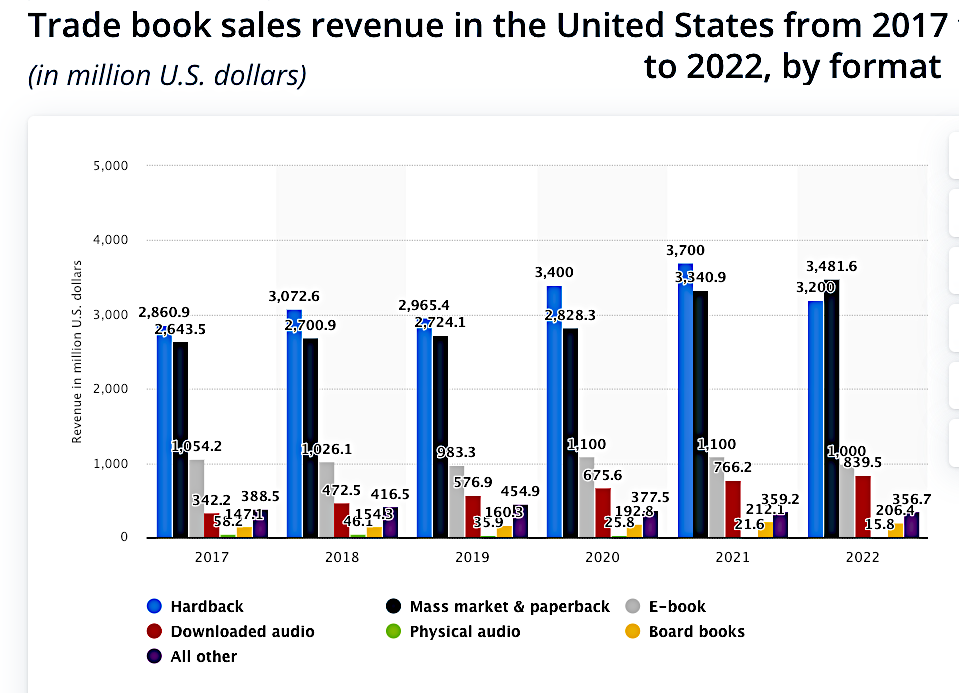
In 2022, data from the Publishers Association showed a 12% decrease in physical book sales, while digital formats continued to show strong growth. Despite the increasing popularity of digital formats, their pricing and the relatively low margins they provide have put pressure on the profitability of many publishing houses. Here is an article on Harper Collins which experienced a 45% drop in profitability.
Though self-publishers often don’t rely on printed books as much as traditional publishers, there is still that downward pricing pressure. For me, the days of keeping books at 99 cents or $2.99 and $3.99 are not sustainable. I’m taking a hard look at how my ebooks are priced, and reworking a pricing model that reflects a pricing model related to both popularity of the genre and length of the book.
I do not recommend, however, doing what big publishers do which is price the ebook at the same price as the print book. They do that in the hopes readers will just buy the print book, where they already have larger profit margins. That is not a winning strategy. Consumers today want digital books and their expectation is significantly lower pricing because, in their mind, there are no costs for paper, printing, and shipping.
2. Market Saturation and Competition
The publishing industry is not insulated from the impact of market saturation. With the rise of self-publishing platforms and a surge in content production, the industry has seen a significant increase in the number of books available to readers.
As reported by Bowker in 2023, over 2.8 million titles were self-published in the U.S. alone, a 21% increase from the previous year. This saturation has intensified competition, making it more challenging for traditional and self-published authors to capture readers’ attention and close sales.

Publishers and authors need to spend significant time finding and nurturing readers in order to compete at all. It used to be that publishers didn’t care about readers. They only cared about the end of the distribution chain. They expected bookstores, online websites, and others to be the reader contact. But with readers being primarily online for all their shopping, including books, those traditional book and mortar stores are also struggling to stay afloat as they learn how to do more business primarily online.
Now, even big publishers are building email lists and doing more direct sales. Finding ways to nurture their readers and keep them close. Many self-publishers have known this for at least a decade, though we (I include myself in this) have strayed from that edict sinking money and time into advertising and other marketing. I’m returning to focusing on nurturing readers in 2024 and beyond. Don’t have an email list? Consider this article I wrote five years ago on why an email list is important.
3. Environmental Challenges
For those who are publishing print books, you probably noticed the big hike in author copies pricing. That is because the cost of paper has gone up and, even more importantly, the supply chain for paper is not reliable. Early last year when Amazon and Ingram sent me a message about the cost of print copies going up, I had to change the pricing on every book in order to make sure I still made some money on the sales. Most of my books went up by a dollar. A few were able to squeak through without a pricing change.
The publishing industry’s reliance on paper has significant environmental implications, notably contributing to deforestation. The World Wildlife Fund reported this year that around 40% of the world’s commercially cut timber is used for paper production. Publishers are under increasing pressure to source paper sustainably. This shift often involves working with certified providers who follow responsible forestry practices. However, these sources are more expensive.
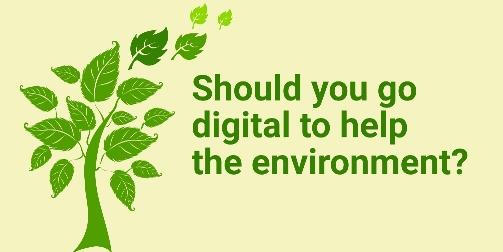
The production and distribution of books also require substantial amounts of energy, contributing to carbon emissions. The carbon footprint encompasses all stages, from paper manufacturing and printing to transportation and disposal or recycling of unwanted books. In 2022, the Green Press Initiative reported that the U.S. book publishing industry emitted over 12.4 million metric tons of CO2 — equivalent to the annual emissions of 2.6 million cars.
Since the digital revolution of ebooks, I’ve often thought that might be a great way to help the environment. No need for paper production, no returns on e-books. Unfortunately, it is not without environmental impact. Digital reading devices require energy for production and use, and they become electronic waste at the end of their life cycle. The increased energy consumption of data centers that host digital content also contributes to environmental concerns.
There are solutions to these environmental concerns and some publishers are investing in those solutions. Self-publishers need to determine if they want to be part of this change. You can do this by choosing distributors who are mindful of their environmental footprint and working to solve the problems.
TUNE IN NEXT SATURDAY, 12-23, FOR PART 2:


