Whenever I start to prepare this post every December, I look back at my previous posts. My post last year focused on four major areas of change: 1) the impact of the pandemic on book products and fan events; 2) the rise in sales of subscription services across the board; 3) International sales expanding at a higher rate than U.S. sales; and 4) Artificial Intelligence (AI) continues to make a major difference in 2021.
Honestly, I think all of those things have continued to accelerate in 2021 and I’m sure will continue into 2022. Anyone who was hoping for a return to a time when online and virtual products are not the primary way of consuming content needs to let go of that dream. Do whatever grieving ritual works for you and, if you haven’t already, prepare to embrace the digital and virtual world if you want to be involved in a career as an author.
Today, I’m going to once again focus on only three of the most important trends I see: 1) the continued impact of the pandemic on book products and fan events; 2) the importance of understanding web-based discovery tools and social media engagement; and 3) the expanding reach and use of AI coming into its own in 2022.
The Continued Impact of the Pandemic on Book Products and Fan Events
The Changing Investment in Print Books
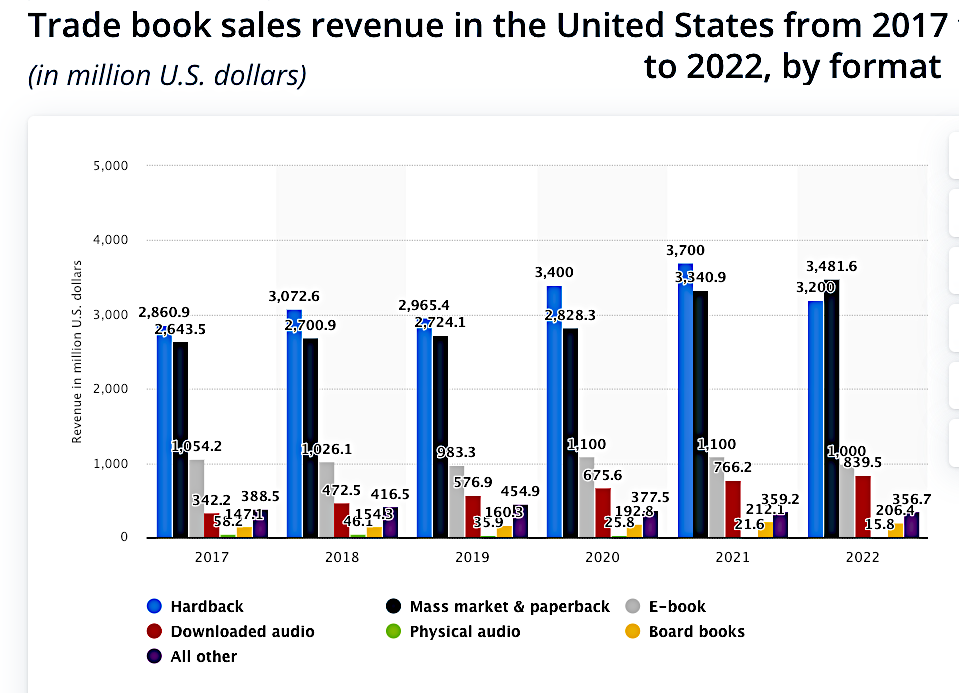
I don’ think print books are going away. Instead, I believe they are being seen as a “premium” product by the majority of readers. There was a good number of readers (primarily those over age 50) who preferred print books or simply didn’t like the idea of reading on an electronic device. However, the pandemic changed that for many of them. Libraries closed, bookstores closed, buying print books became not only more expensive but required shipping. They were no longer a spur-of-the-moment purchase. Supply chain issues frustrated many.
Reluctantly, this older group began trying e-readers or tablets. With practice over the past 20 months, they realized it wasn’t so bad. In fact, there were a lot of reasons for not doing print. You could get books faster and usually cheaper. Even libraries were encouraging digital downloads of ebooks because they’d been closed for so long. With the relative ease of downloading and storing hundreds or thousands of ebooks, the consumer no longer had to worry about where to store another print book, or whether/when they needed to purchase or make another bookcase.
This translated to readers deciding only to invest in a print book if it was special, unique to the times, or may become a collectible. To reach that level of investment requires something extra. The reader loves the author already or, after reading the ebook, loved it so much she wanted it in print for her “collection.” Perhaps one would buy a print book by a favorite celebrity or political leader or highly respected writer as a way to save that as an important piece of history—in a similar way that people still buy Life Magazines as collectibles, even though the final issue came out in 2000, more than two decades ago.
There is one type of print book that continues to be very viable, that is children’s picture books and Early Readers Books—for up to third or fourth grade. Beginning at the Middle Grade level (age 9-13) it starts tipping 70/30 toward ebooks. Print books are bought primarily by libraries and schools instead of consumers. It is not at all unusual that by the age of 9 or 10, children are reading on tablets. Part of that is because of what happened with virtual schooling for the past two years. Parents who never thought their children should be on tablets or computers had to make it happen for school. Even Kindergartners were doing online school. I still believe the value of print for middle grade is there, but I’d also not be surprised if those percentages became 50/50 by 2025.
The Death Knell of Conferences and Book Tours
In 2022, I believe that it will be unusual, costly, and only sold as a premium offering to have in-person conferences, signings, and fan interactions. Now that many libraries, bookstores, and major conference providers, including publishers, invested heavily in the last two years to move those interactions online. I don’t see them returning in the numbers they used to be.
The increase of relatively inexpensive, yet engagement measurable web-based solutions, make it very appealing to big and small publishers alike. Why send staff to a conference and incur the costs of airfare, hotels, food, and paying for booth space when you can put on a virtual event and get all the metadata on attendees to follow-up? This also extends to cutting back on the costly big sales-force that travels to stores and libraries, colleges and conventions. Why do that when you can save hundreds of thousands, or millions of dollars with virtual one-on-one meetings and events.
I don’t think conferences, symposiums and big book events will completely disappear. I believe instead businesses, publishers, authors and fans will choose carefully which one or two events are “worth it” to attend. Among my own followers, many fans have said they save all year for ONE big conference (e.g., Comic Con or a big genre-based conference like the annual Fantasy & Science Fiction Convention or a Romance specific convention). Because of the cost of travel, hotels, food, that they instead plan it as a vacation event. They want authors, free books, break-out discussions, maybe cosplay, etc. So, they will pick the largest and most prestigious events to go to.
What changes this dynamic of going virtual rather than in-person? Paid events. If the publisher or author can make money from a convention or author tour by charging fees to be seen, then it becomes viable again. Sure, they’ll sell books (or maybe give them away if the fee is high enough); but the money is made on the fees not the books. I’ve already seen some of these author tours with NYT authors or celebrity authors. Fans pay to see the author at the same prices they would pay to attend a sporting event or a touring Broadway show.
Don’t believe me? I’ve already seen several events posted in central Willamette Valley in Oregon (well outside of the big city of Portland) with authors at a big arena where prices range from $25 in the nose bleed seats to over $100 to have a seat in the orchestra seats—the large section closest to the stage. These are 5,000 + auditoriums.
The Critical Importance of Web-based Discovery Tools and Social Media Engagement
Whether it is print books, ebooks, or audiobooks—or any new digital publishing opportunities, 2022 will continue to accelerate the many digital trends that began taking hold in 2018 and have only grown during the pandemic. The strongest developments relate to niche development and search engine optimization (SEO), with the development of online communities a strong contender for the top trend. Niche publishers continue to flourish, and they will increase in popularity, especially in the digital publishing realm.
Increase Your Expertise and/or Your Partnership with Knowledgeable Web-based Companies
The need to understand and leverage web-based services has only grown. With the plethora of electronic delivery mechanisms for content (including books) you can no longer be competitive with only a blog or a single social media site like Facebook. You definitely MUST have a website if you want to build brand loyalty. You need to be and several social media platforms, and you need a consistent fan engagement strategy. All of this requires either training to understand how all these elements work together or to partner with a company or person who does understand it and will keep your presence alive.
Money follows ease of use, so authors and publishers need to focus most on website speed and infrastructure. Plan for tomorrow, not just what you are doing today. Emerging content importance includes podcasting, 4K video, and other bandwidth hogs. It is even more critical to understand the role off mobile users which have far outpaced laptop or desktop users. Mobile users expect all content to load just as quickly and easily on their phone as on their desktop computer. Website design plays a vital role in brand building and SEO.
You may need to look into a redesign that focuses on redistributing the information, the navigation, and the SEO to make it much easier for consumers to find your products and content.
Niche Publishing Grows Faster than General Publishing
Small online publishers have honed their niches. Digital publications will further rely on user trust built from quality editorial content. This means that even large publishers are now creating platforms that can collect and visualize niche audiences, use community data to segment their offering, and therefore actually capture more sales through individualized search and follow-up. This is where understanding your unique brand and the “niche” you serve helps you to grow faster than attempting to reach the entire world with a more general approach.
In 2022, it will all be all about building brand loyalty. The best publishers, traditional or indie, will develop content, experiences, and customer service channels for their loyal customers to cultivate “community.” Marketing campaigns will combine networked events with increased partnerships—whether they are other publishers working together or a group of authors working together toward common marketing goals.
Building the audience only begins the process. Publishers also need to monetize traffic, and one 2022 trend is their development of new revenue streams. This may be doing subscription-based or fan-loyalty discounts. Making certain content paid (e.g., select blog posts or podcasts; bonus content; networking options for fans)
Social Media’s Continued and Changing Viability
Just as niche engagement has grown, so has the diversification of social media use both for regular engagement and for advertising. Facebook, Instagram and Twitter still remain with the largest number of users. However, the lack of transparency and continue algorithm changes that limit page reach has made Facebook the least used platform in publishing now. Facebook and Instagram are still good platforms for staying engaged with those who already like you and your brand. They are not considered good platforms for those needing to find new fans.
Twitter has remained relevant for publishers, but it’s short form messaging continues to challenge sales-related opportunities. With a change in Twitter’s leadership beginning in 2022, many people are taking a wait-and-see attitude as to if it is worth sticking with in the future.
Video-based content has grown exponentially in the past year and is likely to continue its rise in 2022. Though YouTube and Vimeo are still a good place for long form video content, their increased reliance on commercial/ad use has made them less interesting for book consumers. And the ease of producing quality video for these platforms is still daunting to the average user.
This is what has made a platform like TikTok so relevant. TikTok has grown far beyond its beginnings in silly dances, pranking, and outrageous humor (though that is still available there). An entire author/publisher network around “booktok” and “authortok” has done very well. I would predict there will be competitive platforms similar to TikTok coming by the end of 2022—perhaps with the allocation of longer videos. The critical design that has propelled TikTok to such wide use is that it is easy to use on a cell phone and one doesn’t have to have a lot of video editing skills to make it work. The downside for some content creators but beloved by many consumers is the shortness of the videos (currently limited to three minutes). This also helps to ensure no bandwidth or buffering problems because of the three-minute limit.
Most interesting to me has been the return to long-form content in some way—blogging , weekly or more newsletters, subscription services for long-form content. For the past three to five years it seemed that many authors/publishers had abandoned the blog to engage in social media and sought out a lot of AI-based solutions for building fans. However, that has slowed much more significantly and people have returned to the long-form content is best at building brand loyalty. In addition, the longer form written content lends itself to increased SEO, which would argue for a way to make newsletters public or post the most important content in a blog to capture that SEO benefit.
An important consideration for Video or Audio-based content is to also have available a transcription of the content. This is good for those with hearing difficulty. It is also excellent for that increased SEO that is critical for indexing your content for search.
The Expanding Reach and Use of AI in All Aspects of Publishing
I’ve been talking about AI for at least three years now, maybe more. And every year, people think I’m crazy. Perhaps it’s because of my technical background. I’ve seen the growth of AI over the past two decades, and it has certainly accelerated in the past three years. In the past I’ve talked about AI in terms of software for productivity—like plotting, all types of story structure building, formatting, and even for creating SEO without having to really understand the back-end coding at all.
But for 2022, AI has exploded in major ways that can make communication easier, reach into foreign markets easier, and the ability for authors and publishers to get more derivative products out the door quickly and with less expense.
You may remember that last year I talked about how foreign sales of books were growing much faster than books sold in the English language market. Part of that is simply a matter of population. Countries like India (1.3 billion people) and China (1.45 billion people) together comprise 37% of the entire world population. It is also a matter of reading habits. You may remember this little infographic from last year (Data from 2017. I haven’t seen an updated one) where both India and China citizens read a lot more hours per week than the US, UK, Canada, or Australia—primarily English-speaking markets.
Translation AI
Think about some of the most exciting holiday gifts this year—things that not that long ago were science fiction. You can now buy a pocket translator that carries anywhere from a dozen languages up to over one hundred. You select the two languages, speak into the device and it’ll quickly say the phrase in the intended language. Because pocket translators are designed specifically for translation, these devices are much faster and more advanced than your normal smartphone translator app or Google Translate. This is based 100% on AI--software programs built to learn and get better as they are used and corrected over time.
Why does that matter to authors and publishers? Because the cost of translating a book has now gone down significantly. Instead of the usual $5,000+ for the average novel, it has come down to under $100. Will you want to use a professional translator to check it? Probably—especially if you use a lot of slang or colloquial speech, or onomatopoeia—in your book. But, in my experience, with using DeepL and having native speaker/readers (not translators) review the entire book, it is 95% or more already there. The cost for me? One month’s payment of $6.99 which allows for up to 5 files to be generated. So, for $6.99 I can go from English to German, French, Italian, Spanish, and Japanese if I like. Or whatever mix of the 24 language selections DeepL currently processes. It is 100% AI, using neural networks and learning so it gets better with the number of users and reported corrections.
With good translation I have the ability to take a book in English and potentially make it 24 products. But translating to languages spoken in countries with high reading rates would make the most sense. Equally important is that translation helps with other AI partners as well.
Text to Speech AI for Audio
Audiobooks are another area that has been booming. Still increasing in double digits, data for 2021 is look at about 25% increase year over year. In the past text to speech AI has sounded very robotic. It then improved to not being so robotic but still devoid of emotion (think of Data in StarTrek before he got an emotion chip). It has now, at least in short iterations, become more realistic. In fact, in each of the ones featured here, one can go back and tweak the algorithm in certain passages or as a whole to be more “emotional”.
I’ve listened to a number of short parts AI narration for each of the platforms mentioned below. Is it perfect? Darn close. After listening to an entire chapter (15-20 minutes) one can start to hear/feel the repetitive pattern of the voice. But I’m not sure it makes it less real. After all, every narrator has a certain pattern to their voice. Clearly, I think one could use AI without a problem for nonfiction.
In terms of fiction, I think it has more to do with each author’s expectations of emotion and the possible desire for a change in pitch or character voice that only a professional actor provides. Also a change in softness or loudness that can sometimes add to the scene. For some fiction authors, none of that is important. They aren’t looking for an “acted” narration, instead preferring a “reading.” In that case the quick timing and price may be well worth it.
Here are three top AI Narration tools that I’ve looked into: Deep Zen, Scribe Audio, and Speechki. All of these have some similar mechanisms. They all have a catalog of voices that have already been input into the system. These are voices from professional narrators who have agreed to have their voice “cloned.” What that means is that the system has an understanding of how each narrator’s voice rises and falls during a sentence, how long of a pause they typically make at a comma or a period. What types of markings (e.g., an explanation point vs a semi-colon) or keywords (sad, mad, angry, quiet, loud, etc.) indicates a change in voice level or pacing. Then the AI processes all that and, just like the language translator I mentioned above, learns how to put words together and make them sound “natural.”
All three of these systems also have the ability for the author, or any chosen narrator, to provide their own voice to be “cloned” and then used to narrate the book with the AI processing. Kind of a way to sound like yourself but not have to do the hours and hours of recording. ☺
The time it takes to produce an audiobook ranges from a month, in the case of DeepZen, to 15 minutes if it is total AI. The cost also varies typically from $500 on the low end for more the more “common” voices to $1,000 on the high end for a “high quality” voice. That is about 1/3 to ½ the likely cost to pay the minimum SAG/AFTRA price of $225 per finished hour, which for a 65K book would be a little over $1,500.
Of the three mentioned above, Scribe says they also employ a team of “literature analysts” who go through each page and enter metadata that will help to increase the emotion when the AI does the narration. Being a metadata geek from the old days of building standardized modules, that intrigues me. I suspect it also means the end product costs more because they’ve employed a real human to interpret things in advance. They don’t provide pricing on their website and it appears their primary immediate aim is to work with big publishers who want to take a large portion of their catalog through this system to put out audiobooks.
Speechki also excites me because they are the only one with a mission to provide narration beyond the English language. The idea is that the end user (the listener) can choose which language they wish to listen in. So Speechki would have the ability to switch to any one of 72 languages. They currently have 251 voices in 72 languages, including more than 50 American voices. They have already processed upward of 1,000 books, mostly in Swedish and Russian. I am unsure exactly how this process works as there is not a lot of discussion about it on the website. I also wonder (perhaps assume) that one would have to provide a translation for each language in order for it to be but to a specific language AI, but am unsure.
FINAL THOUGHTS
There is no doubt that competition as a whole is increasing. There are more books and book products being put out every year by both traditional publishers and indie publishers. Just in the decade I’ve been immersed in publishing I’ve seen a big shift in both the competitiveness and the costs to individual authors and to big publisher. This means that the more one can differentiate themselves from the masses the more likely you are to succeed.
This doesn’t mean your book needs to be wacky or completely different from any book out there. Nor does it mean if you write tropey genre fiction that you don’t stand a chance of success. But it does mean it needs to have a unique hook or presence in the zeitgeist to make it stand out and rise in the marketplace. Each book is competing against big publishing and the market and money it controls, against authors who already have a solid platform and track record of excellence, and everyone else who writes books with similar themes, goals, or genre tropes as your book. So, how do you stand out? That goes back to knowing your niche, and building a brand that people want.
Books are just one creative product that is developed from the words you write, the stories you tell. In 2022 and beyond, it may be that the written word will no longer be the primary product. It may be that audiobooks, or video content, or some combination of print, ebook, audio, and video will be needed to compete. The more you see your book as a single product that has the capability of being many products, the more likely you are to make money off of your creations. Also, the more likely you are to gain fans who can access your creation in a way that they most enjoy.
I now automatically think of every book I create as a minimum of three products: ebook, print book, and audiobook. But I also think beyond that if I’m writing in series or connected stand-alones. I think of box sets of ebooks, print and audio. I think of possible serials of a single book or a group of books. I think of potential NFT products (collectible special books that add things no other book of that title contains). I think of a product that combines ebook and audiobook in one product. I think of a product that perhaps contains video or some enhanced interactivity in addition to the ebook and audio. In other words, every story or nonfiction content I write has the possibility for multiple derivative and combined products.
I believe AI will help in the creation of some of those combinations. I believe licensing rights will help in the creation of some of those combinations. I believe learning to create those combinations myself is another possibility. In the end, what I really want is for the story, the narrative to get out there; and for it to speak to someone who finds joy or learning, or is simply entertained.
Happy 2022 Writers and Readers! May your creations find their niche and bring meaning
and joy to all those who encounter them.
Maggie Lynch is the author of 27 published books, as well as numerous short stories and non-fiction articles. Her non-fiction focuses on guiding authors to business success in their career.
Her fiction spans romance, suspense, fantasy and science fiction telling stories of men and women making heroic choices one messy moment at a time.
You can learn more about Maggie and her books at https://maggielynch.com Facebook | Twitter | Instagram | LinkedIn |