
"If men must hate, perhaps its just as well that they make no Christmas Truce."
So said the New Yorker just before Christmas, 1914. The recently elected Pope Benedict XV had appealed to Europeean leaders for a Christmas Truce, so that “that the guns may fall silent at least upon the night the

A severe frost swept across the Western Front on December 24th. In some places, snow fell. Water froze in the trenches around soldiers' feet. Leutnant Walther Stennes of the German 16th Infantry Regiment and his companions opened letters and parcels sent from home, all the while amazed by the quiet:
“We opened the parcels and tried to be a little like at home— write letters. Of course it was unusual that the opposite side also ceased fire, because they always maintained sparse rifle fire. … The night passed, [and] not a single shot was fired.”
On the other side of the barbed wire strewn no man's land seperating the warring sides, Allied soldiers were also opening letters and parcels from home. Private William Quinton, of the 2nd Bedfordshire Regiment, noted:
“Here and there, showing just above their parapet, we could see very faintly what looked like very small colored lights.… Suddenly, across the snow-clad no man’s land, a strong clear voice rang out, singing the opening lines of “Annie Laurie.” It was sung in perfect English, and we were spellbound.…As the last notes died away, a spontaneous outburst of clapping arose from our trenches. Encore! Good old Fritz!”

The signs of a thaw in relations gave men the courage to test the waters despite the obvious risks involved in climbing out of their trenches. Imagine the bravery it took for the first man to lift his head and step out of the relative safety of the trench onto the No Man's Land littered with days or weeks worth of dead bodies. Cautiously at first, by ones and twos, and then by the thousands, soldiers from both sides put down their rifles and crawled out of their trenches to greet one another. Men whose bullets and bayonets had been ripping each other apart for weeks now exchanged handshakes and words of kindness. The soldiers traded songs, tobacco and wine with men like themselves, not the monstrous creations of propaganda.
The unplanned truce spread organically. Not everyone on the Western Front took part in the truce. Firing continued in many places. One soldier who did not agree with any kind of truce was a young German corporal named Adolf Hitler. Although Hitler’s unit was not on the front lines that Christmas, the future Nazi leader and instigator of the second world war derided the truce, saying,
Still an estimated two-thirds of the troops on all sides engaged in the once in a lifetime truce. While it lasted, the truce was magical, leading even the Wall Street Journal to observe: “What appears from the winter fog and misery is a Christmas story, a fine Christmas story that is, in truth, the most faded and tattered of adjectives: inspiring.”
Descriptions of the Christmas Truce appear in numerous diaries and letters of soldiers from both sides. A British rifleman named J. Reading wrote a letter home to his wife describing the experience: “And our chaps went out to meet them…I shook hands with some of them, and they gave us cigarettes and cigars. We did not fire that day, and everything was so quiet it seemed like a dream.” Another soldier, named John Ferguson, recalled the event with the words: “Here we were laughing and chatting to men whom only a few hours before we were trying to kill!” A German infantryman described how a British soldier set up a makeshift barbershop, charging Germans a few cigarettes each for a haircut.
In an interview recorded in the 1960s, German Lieutenant Johannes Niemann, of the Saxon 133rd Regiment told of a soccer game played no man’s land:
In some parts of the Front, the truce only lasted for Christmas Eve or Christmas Day itself. Elsewhere it continued for several days, extending to New Years day. The truce enabled soldiers to celebrate Christmas in a freer, more jovial and above all safer environment. It felt like a dream, gave the men much needed rest, and allowed them to satisfy their natural curiosity about one another. Members of both sides seized the opportunity to work on improving conditions in their trenches, which were, in a word, horrendous. The truce also allowed both sides to bury dead comrades whose bodies had been left exposed for days or even weeks out in the no mans land between enemy trenches.
For Captain Charles Stockwell, of the 2nd Royal Welsh Fusiliers, the truce ended early on Boxing Day, (the day after Christmas). The transition from peace back to war was handled with courtesy.
The 1914 Christmas truce did not mark some deep flowering of the human spirit rising up against the war. It was a break from reality, not the dawn of a brave new peaceful world. There have been tales of pauses in the middle of even the most violent conflicts, of truces to allow the dead to be buried, ever since the Iliad and the war against Troy. None has been as famous, as earth shattering, as real as the truce that occurred on the wester Front in France and Belgium in the first year of the so-called Great War. The war that actually did nothing to end all wars.

The peace, short-lived as it was, did something that still resonates today, more than a century later. The event has been immortalized and fictionalized in children’s novels like Michael Foreman’s War Game, in films such as Joyeux Noel and Oh, What a Lovely War! and even a 1960's song called Christmas Bells featuring Snoopy, the Beagle in the "Peanuts" comic strip, battling the German Red Baron.
In the hundred plus years since that time, the event has been seen as a kind of miracle, a rare moment of peace just a few months into a war that would eventually claim over 15 million lives. It was only a truce, not peace or moral epiphany. Troops willingly went back to war against people they had just broken bread with and exchanged presents with. Even after meeting and putting a face to their enemies, the average soldier remained ready to accept orders to kill without hesitation.
Worse still the Great War wreaked such destruction and devastation that soldiers soon grew hardened to brutality. There were scattered burial parties and brief cease-fires at Christmas in 1915. By 1916, the animosity on both sides and the utter brutality of the war quashed any chance of another holiday humanitarian initiative. As far as we know, this kind of organic truce has never happened in a war before, or since.
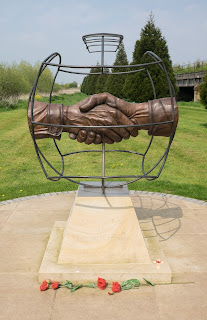
Today, a memorial stands in England’s National Memorial Arboretum commemorating the Christmas Truce: a metal frame representing a soccer ball, with two hands clasped inside it. It was dedicated by Prince William of England on December 12, 2014. On the 100 anniversary in 2014, the English and German national soccer teams staged a friendly match in remembrance of the soldiers’ impromptu soccer games in 1914.
“Such a thing should not happen in wartime. Have you no German sense of honor left at all?”
Still an estimated two-thirds of the troops on all sides engaged in the once in a lifetime truce. While it lasted, the truce was magical, leading even the Wall Street Journal to observe: “What appears from the winter fog and misery is a Christmas story, a fine Christmas story that is, in truth, the most faded and tattered of adjectives: inspiring.”
Descriptions of the Christmas Truce appear in numerous diaries and letters of soldiers from both sides. A British rifleman named J. Reading wrote a letter home to his wife describing the experience: “And our chaps went out to meet them…I shook hands with some of them, and they gave us cigarettes and cigars. We did not fire that day, and everything was so quiet it seemed like a dream.” Another soldier, named John Ferguson, recalled the event with the words: “Here we were laughing and chatting to men whom only a few hours before we were trying to kill!” A German infantryman described how a British soldier set up a makeshift barbershop, charging Germans a few cigarettes each for a haircut.
In an interview recorded in the 1960s, German Lieutenant Johannes Niemann, of the Saxon 133rd Regiment told of a soccer game played no man’s land:
A Scottish soldier appeared with a football, which seemed to come from nowhere, and a few minutes later a real football match got underway.… A great many of the passes went wide, but all the amateur footballers, although they must have been very tired, played with huge enthusiasm.… The game finished with a score of three goals to two in favor of “Fritz” against “Tommy.”
In some parts of the Front, the truce only lasted for Christmas Eve or Christmas Day itself. Elsewhere it continued for several days, extending to New Years day. The truce enabled soldiers to celebrate Christmas in a freer, more jovial and above all safer environment. It felt like a dream, gave the men much needed rest, and allowed them to satisfy their natural curiosity about one another. Members of both sides seized the opportunity to work on improving conditions in their trenches, which were, in a word, horrendous. The truce also allowed both sides to bury dead comrades whose bodies had been left exposed for days or even weeks out in the no mans land between enemy trenches.
For Captain Charles Stockwell, of the 2nd Royal Welsh Fusiliers, the truce ended early on Boxing Day, (the day after Christmas). The transition from peace back to war was handled with courtesy.
At 8:30am I fired three shots in the air and put up a flag with “Merry Christmas” on it, and I climbed on the parapet. He put up a sheet with, “Thank you” on it, and the German captain appeared on the parapet. We both bowed and saluted and got down into our respective trenches— he fired two shots in the air, and the war was on again!
The 1914 Christmas truce did not mark some deep flowering of the human spirit rising up against the war. It was a break from reality, not the dawn of a brave new peaceful world. There have been tales of pauses in the middle of even the most violent conflicts, of truces to allow the dead to be buried, ever since the Iliad and the war against Troy. None has been as famous, as earth shattering, as real as the truce that occurred on the wester Front in France and Belgium in the first year of the so-called Great War. The war that actually did nothing to end all wars.
The peace, short-lived as it was, did something that still resonates today, more than a century later. The event has been immortalized and fictionalized in children’s novels like Michael Foreman’s War Game, in films such as Joyeux Noel and Oh, What a Lovely War! and even a 1960's song called Christmas Bells featuring Snoopy, the Beagle in the "Peanuts" comic strip, battling the German Red Baron.
To see a video of the song, click:
In the hundred plus years since that time, the event has been seen as a kind of miracle, a rare moment of peace just a few months into a war that would eventually claim over 15 million lives. It was only a truce, not peace or moral epiphany. Troops willingly went back to war against people they had just broken bread with and exchanged presents with. Even after meeting and putting a face to their enemies, the average soldier remained ready to accept orders to kill without hesitation.
Worse still the Great War wreaked such destruction and devastation that soldiers soon grew hardened to brutality. There were scattered burial parties and brief cease-fires at Christmas in 1915. By 1916, the animosity on both sides and the utter brutality of the war quashed any chance of another holiday humanitarian initiative. As far as we know, this kind of organic truce has never happened in a war before, or since.
Today, a memorial stands in England’s National Memorial Arboretum commemorating the Christmas Truce: a metal frame representing a soccer ball, with two hands clasped inside it. It was dedicated by Prince William of England on December 12, 2014. On the 100 anniversary in 2014, the English and German national soccer teams staged a friendly match in remembrance of the soldiers’ impromptu soccer games in 1914.
By the way, England won that 2014 game, 1-0.


