Showing posts with label celebrating romance. Show all posts

Tuesday, September 27, 2016

Celebrating Romance When Life Goes to Hell By Sarah Raplee

First published May 28, 2013
As a writer, I learned early on the value of celebrating romance when life goes to hell. During introductions at my first local chapter meeting of Romance Writers of America in West Des Moines, Iowa, a young woman’s story gave me a new perspective and pride in my newly-chosen career. I've heard similar stories over and over.

 “Reading romance helped me through my father dying of cancer. That’s why I decided to write romance novels. I want to do the same for other people,” she said. For that horrible year, romance stories were a great escape from the pain and grief that was her daily life. And the experience of finding love and happiness in the darkest of circumstances that reading romance offered gave her hope—which is always worth celebrating. Laughing through light-hearted romantic comedies lifted her spirits and offered a respite in which to renew her strength.

As a reader, I experienced the power of celebrating romance when my husband went from healthy and strong to the brink of death in twelve short hours. We were in the process of moving to a new home when our timid, neurotic housecat, Jasper, transformed into murderous Demon Spawn. 

In an effort to calm Jasper, we decided to put the confused and frightened fifteen-pound orange tabby into his cat carrier. To avoid getting scratched and clawed, Chuck made the mistake of grasping the cat’s front legs in one hand and his hind legs in the other and picking him up. Jasper just wasn’t the sort of cat you find on the television show, My Cat from Hell. That our cuddly pet would bite him never occurred to my husband.


But Jasper acted on pure animal instinct, defending himself from what seemed like attack with the deadly tools God had given him. He bit my husband’s hands and arms multiple times, going all the way through the ring finger on his left hand. Later, the ER doctor had to cut his gold wedding band in to places in order to remove the ring. 

Despite the cat’s efforts, Chuck got him into the cat carrier. Blood streamed from his wounds, but being a man, he refused to go to the emergency room. In spite of my protests, he insisted on washing the wounds himself with soap and water, pouring peroxide over them, stopping the bleeding, and then helping my sons finish loading the moving van. 

By the time the truck was unloaded and turned into the rental place, it was 11:30 pm and we were exhausted. His hands and arms hurt like the devil, but he was sure that was from being bit and moving things. We went to bed.

The next morning, he had a fever and two wide red streaks running up to his armpits. His fingers were swollen like sausages and he felt dizzy. He was too weak to fight going to the ER.

Turns out that, according to the hand surgeon who was called into the ER, 90% of cat bites get infected. For comparison, only 5% of dog bites do. Feline mouths harbor a nasty strain of bacteria. Anyone bitten by a cat should make a beeline for the nearest urgent care center or emergency room.
Chuck’s severe bite wounds were infused with millions of potentially-lethal bacteria who had multiplied overnight until the infections had spread almost to his heart. Reaching his heart would have been fatal. 

ME & FRECKLES
OUR CURRENT RESCUE CAT
GIFT FROM HUBBY
Microsurgery was performed on Chuck’s hand. Years later he still has no feeling in part of that finger. He spent five days in the hospital with IV antibiotics being pumped directly into his heart. He left the hospital on Christmas Eve with a portable pump and the IV still in him. I spent those five days on a bedside vigil alternating between praying and reading a romance novel. 

My faith gave me the strength to function. Celebrating romance kept me sane. 

Has celebrating romance helped you through a hellish situation?

Tuesday, June 21, 2016

Brown's Matrimonial Method


Brown's Matrimonial Method
A Vignette of Victorian Advice

from:
Marriage and home : or, proposal and espousal : a Christian treatise on the most sacred relations to mortals known, love, marriage, home
by "A Clergyman"
Published 1888, Copyright 1886 (now in the public domain)
[See source links at bottom of article.]

"Brown, I don't see how it is that your girls all marry off as soon as they are old enough, while none of mine can marry."

"Oh! that's simple enough. I marry my girls off on the buckwheat straw principle."

"But what is that principle? I never heard of it before."

"Well, I used to raise a good deal of buckwheat, and it puzzled me a good deal to get rid of the straw. Nothing would eat it, and it was a great bother to me. At last I thought of a plan. I stacked my buckwheat straw nicely, and built a high rail fence around it. My cattle, of course, concluded that it was something good, and at once tore down the fence and began to eat the straw. I drove them away and put up the fence a few times, but the more I drove them away, the more anxious they became to eat the straw. After this had been repeated a few times, the cattle determined to eat the straw, and eat it they did, every bit of it. As I said, I marry my girls off on the same principle. When a young man I don't like begins calling on my girls, I encourage him in every way I can. I tell him to come as often and stay as late as he pleases, and I take pains to hint to the girls that I think they'd better set their caps for him. It works first-rate. He don't make many calls, for the girls treat him as coolly as they can. But when a young fellow that I like comes around, a man that I think would suit me for a son-in-law, I don't let him make many calls before I give him to understand that he isn't wanted around my house. I tell the girls, too, that they shall not have anything to do with him, and give them orders never to speak to him again. The plan works first rate. The young folks begin to pity each other, and the next thing I know they are engaged to be married. When I see that they are determined to marry, I always give in, and pretend to make the best of it. That's the way to manage it."


See the full text of this Victorian-era book:

Note: the transcription, above, is precisely as it appears in the original text on pp 129-130, including paragraphs.


Because I write Sweet Victorian American West Romance, I'm particularly interested in attitudes about courtship and matrimony in the 19th century and found this vignette amusing. As a mother, I see human nature hasn't changed in the intervening 128 years. Much has changed since the Victorian West; much has remained constant.

What do you think of Brown's advice? Is it as applicable today as it was in 1888?


Hi! I'm Kristin Holt.

I write frequent articles (or view recent posts easily on my Home Page) about the nineteenth century American west–every subject of possible interest to readers, amateur historians, authors…as all of these tidbits surfaced while researching for my books. I also blog monthly at Sweet Americana Sweethearts (first Friday of each month) and Romancing the Genres (third Tuesday of each Month).

I love to hear from readers! Please drop me a note. Or find me on Facebook.


Copyright © 2016 Kristin Holt, LC

Tuesday, August 13, 2013

My Family Reunion - the Saga Continues

by Madelle Morgan

My sister teaches our niece (15) to sailboard.


My three sisters, mother, aunt and I rented a nine bedroom lodge at a lake for a week in July and shared the cooking.


The family is distributed among multiple towns and cities. Winter storms make it difficult to get together in December. 

Our annual summer reunion is the only opportunity to connect with family members in person – a time to take the pulse of each other’s lives and celebrate milestones. This year one niece was recently engaged and another just graduated from college, two nephews will start high school and college respectively in the fall, a sister and her latest partner (third time’s a charm) bought a house, we celebrated my mother’s 80th birthday, and we collectively acknowledged the five year anniversary of our husband-brother-father-grandfather’s passing.

Reunions can be wonderful. Family history is shared. Old memories are exhumed for dissection and reassembly. Each person who was present at an event has a different perspective, like piecing together puzzle pieces into a more accurate big picture view. Our kids grow up so fast. There’s a sense of time running out for the older family members: “We’d better get together while they’re still in good health.” Time together is precious and fleeting.

Reunions can be enlightening. After a few glasses of wine in the dark on the porch, secrets can surface. You find out things they’d never reveal on the phone or in email. Advice is given and ignored. Relationships strengthen due to sharing experiences and “what’s-going-on-in-my-life”.

Reunions can shape who is considered part of a family, whether they're biological relatives, dear friends, or current and former partners and their relatives. Some people aren’t welcome at a reunion, some are missed, some are considered just plain embarrassing... especially by sensitive teens.

Oh, the gamut of feelings associated with family: love and romance, conflict, jealousy, coming of age, tragedy, drama, comedy, old and fresh grievances, joys and sorrows, and on and on.

Is this emotional range why family sagas are so popular with readers? Is it because readers identify with the characters’ problems and goals? Or do they simply love to read about complex family relationships? Or they’d like to discover solutions to their own family issues?

Do you love reading novels about families, and if so, why?

Tuesday, June 11, 2013

Daddy's Girl

by Madelle Morgan


She was Daddy’s girl... until her father took up with a twenty-two year old.

What happens when Daddy has an affair and leaves the family? And what if the daughter discovers Daddy may be a crook?

Petra, the heroine of Diamond Lust, shut her father, Edward Paris, out of her life when he divorced his wife to marry the lab assistant half his age. Petra’s thirteen year old heart turned to stone, fractured from the hurt, the anger, the sense of abandonment. She learned that to love was to feel agonizing pain, and vowed to guard her heart.

After Petra grew up and began working as a geologist, she avoided romantic relationships. Her boss, Hank Horvath, became a father figure. Her work buddy Carter Lee became the brother she never had.  Because her father left.

Petra shifted her loyalties to her new “family”.  But then media reports accuse Edward Paris of falsifying the number of diamonds found in exploratory drill core, thereby fraudulently misrepresenting the value of the Ptarmigan Diamond Mine. Investors stand to lose millions. Only fresh analysis by an independent lab will validate her father’s honesty and save him from prison.

Is her father a cheat across the board? Petra must know the truth. She agrees to collect new drill core for testing. Unfortunately desperate men at the remote mine site in the Canadian Arctic have no intention of letting her succeed.

Stranded at the fly-in only mine, Petra is betrayed by those she thought had her back. 

She falls like a rock for an undercover cop she’s afraid to trust. 

She dodges hidden enemies who’d kill for stolen diamonds. 

She faces the uncomfortable truth that her father had steadfastly loved a daughter who refused to accept that love.

Is it worth her life to clear her father’s name?

What would you do for your father? Would he do the same for you?

U.S., Canada and U.K.

www.madellemorgan.com


Sunday, May 26, 2013

Wearable Art from Canada's Far North

by Madelle Morgan


A proud Canadian, I’ve been fortunate to travel across Canada from the Atlantic to Pacific to Arctic coasts. I’ve lived in three provinces but the highlight of my vagabond life was the adventure-filled five year period I lived in the Northwest Territories (NWT). Together with the other two northern territories – Nunavut and Yukon (adjacent to Alaska) – the territories in grey on the map comprise Canada’s last (and bitterly cold) frontier. 


During frequent trips for my first job after graduating with a degree in civil engineering, I stayed for a few days or weeks in isolated communities of only a few hundred indigenous First Peoples. These tiny hamlets are scattered hundreds of miles apart along the vast Arctic Ocean coastline and on the shores of major rivers and lakes for traditional access to hunting, fishing, and trading. I flew in small planes across the northwest passage to barren Ellesmere, Baffin, Victoria and Banks Islands literally at the top of the world.

Above the treeline, the only trees you’ll see are on satellite TV or the internet. The Inuit maintain ancient traditions of handcrafting clothing and footwear from tough waterproof sealskin to withstand fierce winter winds and -60 deg Fahrenheit.

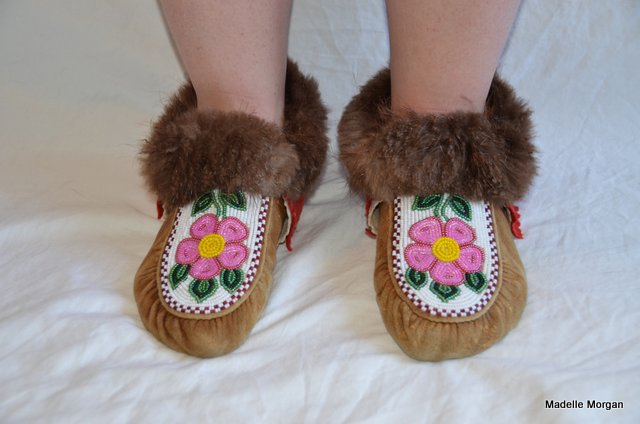
Below the treeline, the Dene aboriginals had contact with fur traders who introduced imported European woolen cloth and beads. The Dene women today continue to design and sew articles of clothing and footwear made from caribou, moose hide and stroud (a type of woolen cloth that was originally made in Stroud, UK). The items are trimmed with beaver or rabbit fur, and decorated with beads, embroidery or dyed porcupine quills in patterns similar to those of their North American aboriginal and Métis counterparts below the 60th parallel.

I was lucky to buy wearable art from the Dene and Inuit at the source; that is, direct from co-ops or women in the communities. Here are photos of items in my personal collection. 


Custom Beaded Moccasins
I supplied an outline of my foot on a sheet of paper to a Dene woman in a Great Slave Lake community, and received the beaded slippers a few weeks later.

In winter indoors I wore these cozy mukluks below lined with stroud and trimmed with dyed rabbit.


Beaded Lined Mukluks

These are my well-worn leather mittens from Baffin Island, trimmed with sealskin. The removable stroud lining facilitates drying.


Embroidered Lined Mittens

Stroud Lining


Below the treeline you'll see many wearing Dene mittens like the ones below. Northerners wear thin gloves inside the mitts. When fingers are needed to grasp objects, they can drop the outer mitts and let them hang by the strings.

Caribou Hide Mitts


Rabbit Fur Mitts

My son, one quarter Métis, inherited creative ability. Note the early sign – a green marker ‘decoration’ on the right canvas upper of his toddler-sized mukluks!

Embroidered Stroud Hat and Lined Mukluks
Alas, I never learned to do beadwork. However I found a blog post by a lucky young teacher in Hay River, NWT who writes about her lessons from the real deal – a Dene Elder.  

If you’re yearning to own similar Dene handmade products, you don’t have to travel to the northern communities anymore to buy them! See my Pinterest Diamond Lust board for examples of northern wearable art available for purchase on-line.

Bio: Madelle lived in Yellowknife, Northwest Territories, the Diamond Capital of North America, in the early 80s. She drew from her first hand knowledge of the north to write a romantic suspense, Diamond Lust, about a beautiful geologist who becomes trapped at a remote diamond mine with desperate smugglers who will do anything, including murder, to escape to Yellowknife with millions in rough diamonds. The geologist’s only ally is a cop undercover as her pilot boyfriend to infiltrate the fly in-only mine site – and he insists on sharing her room.

See Diamond Lust reviews and posts about Life Up North at www.madellemorgan.com