Showing posts with label WWII. Show all posts

Wednesday, November 29, 2023

The Story Behind The Story by Sue Moorcroft

     Authors are often asked where they got the idea for a book. When I’m asked, I sometimes struggle to answer, because it’s something as nebulous as an old bullying case I remembered or an anecdote I was told.

Truthfully, there is a connected anecdote to The Christmas Love Letters. My dad used to tell me a story about one of his ‘aunties’ (which could be a cousin or a family friend rather than a blood relative) as her wartime husband went missing in action. Long after the war, just as she was preparing to request that  he be declared dead so she could remarry, up the missing husband popped.

He’d been hiding out in Italy all this time … 

Society being as it was in the fifties, she was given the choice of resuming life as his wife, or to get out without shared property – because as a married woman, her husband controlled the lot – and to face a world that disapproved of divorce. This injustice stayed with me, and although I’ve given Maddy a husband who vanished from a clifftop one snowy night, I also gave her a lot more options than those of my dad’s aunt.

But that’s just a subplot. 

The idea for the main thread was literally put in my hands. I was at a writers’ conference, Swanwick Writers’ Summer School, and a lady asked me to take a bundle of letters. They’d been written to her late sister-in-law and she didn’t want them around. They were an embarrassment, but she recognised their value in social history terms, and so she’d hesitated before throwing them away. Did I think I could make a story out of them?

To be honest, I was reluctant. I don’t enjoy people suggesting subjects for my books. But I took them to my room and began to read. I think I’d read two before ideas began to bombard me! The letters cover nearly thirty years of contact between illicit lovers. When they met in the seventies, he was a sergeant in the same British army regiment in which my father served (I’ve just realised Dad comes into this post twice!) and she’d been a civilian working with the army. I recognised the world he wrote about from my army childhood, and her experiences as a woman were universal. 

I was hooked, and when I reached the end of the letters, I desperately wished I could just go to Amazon and download the final instalment.

As that wasn’t possible, I wrote The Christmas Love Letters instead, beginning with Raff turning up in a seaside village with the love letters Maddy’s great-aunt Ruthie wrote to his dad. I changed all the names, of course, but I kept the locations and the voices of those long-ago lovers, filling in the blanks and projecting into the future. 

Writing The Christmas Love Letters was a labour of love. And though I usually hesitate to admit that I like one of my books over the others, I am very fond of this one!

Sue Moorcroft is an award-winning and
 internationally bestselling author and has reached the coveted #1 spot on Amazon Kindle UK. 

Her novels, short stories, serials, columns, writing ‘how to’ and courses have appeared around the world. If you’d like to see more of her covers go to www.suemoorcroft.com and click on ‘Gallery’.

Twitter  [@suemoorcroft]

Saturday, November 26, 2022

Joan Ramirez salutes her Uncle William, A Man for all Seasons

I give a literary salute to all the veterans on their special day by talking about a man with dignity, humility, and grace: My Uncle William, a Brooklyn, New York pharmacist who served his country on the North African and Italian fronts in WWII. He was a Renaissance man who spoke, read, and wrote fluent Italian, played the harmonica and piano, and could recite Shakespeare’s works from memory.

This selfless man once saved a customer’s son from choking when something caught in his throat while William was preparing his father’s prescription.

As a medic on the battlefield, William could tend to a soldier’s wounds with precision, care, and compassion.


His commitment to keeping the troops focused never wavered. When their Higgins boat landing craft neared the bullet ridden Italian coastline, William pulled many wounded soldiers to safety behind rocks, ignoring his own welfare to comfort a dying comrade. In North Africa his medical efforts to shield the wounded from the constant onslaught of a blazing sun were known throughout the platoon.

From sprained shoulders to shrapnel in the knees and everything in between, he kept calm and administered aid to America’s finest patriotic soldiers.

At war’s end, each year for the rest of his life, he donned the uniform he’d worn overseas with honor and dignity and saluted his fallen comrades.  He never stopped waving the Stars and Stripes in his hand.

Now, it is up to me to carry the torch and honor his Great War and peacetime deeds by publishing his war memorabilia, a testament to his dedication to this country. 


You can learn more about Joan by visiting her WEBSITE: 

www.joansbookshelf.com

Tuesday, November 12, 2019

I’ll be Home for Christmas By Eleri Grace

Many classic Christmas songs, stories, and films date to the 1940s, to WWII in particular, and with good reason. Almost half the popular Christmas tunes performed and played today were written and originally recorded in the 1930s-40s, with the majority of the remainder dating to the 1950s-1960s.

Why such an outpouring of creativity in celebration of Christmas? Homesick American soldiers, together with their lonely sweethearts, wives and mothers on the home front, spurred a nostalgic idealization of the holiday. These Christmas tributes sound universal themes of love, fellowship, hope and resurgence, presenting a stark contrast with the harsh realities of war. Through the vehicle of popular culture, artists united Americans in common purpose and camaraderie. 

Christmas Eve will find me
Where the love-light gleams
I’ll be home for Christmas
If only in my dreams.
                         
Kim Gannon, Walter Kent, and Buck Ram (1943)


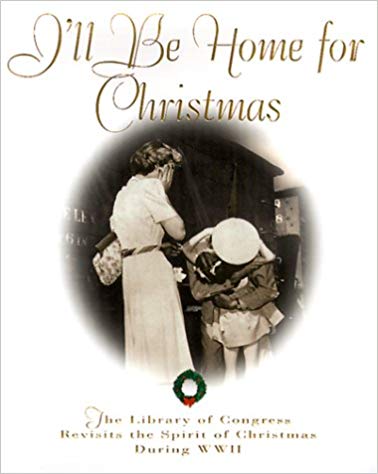
This beautiful Library of Congress compilation of photographs, essays, magazine articles, journal entries and other reminiscences is the perfect way to step back in time to the bygone era of WWII this holiday season. It captures the spirit of the men and women serving overseas, as well as the hopes and fears of those who kept the home fires burning, who longed for the safe return of their loved ones.

The heroines of my Clubmobile Girls novels helped alleviate the acute homesickness experienced by so many young soldiers as Christmas neared. Suppressing their own longing for the comforts of home, the Red Cross Girls threw themselves into creating innovative holiday decorations, procuring gifts, and hosting holiday parties. Wherever possible, American soldiers were anxious to spread Christmas cheer to locals, particularly to area children. Red Cross Girls worked with the military to plan and pull off these festive celebrations that brought so much joy to the young men fighting the war so far from home.

 
In my debut novel Courage to be Counted, my heroine Vivian experiences an intense longing for her sweetheart and for home while singing “Silent Night” at a party the Red Cross and men of the 305th Bomb Group hosted for village children in England. The party she and her friend Mabs plan would have looked something like this photograph from the 379th Bomb Group in Kimbolton, England.
379th Bomb Group (National Archives)


Photo ID: 342-FH-3A-14449-65542AC.

Meanwhile, her hero Jack wishes desperately that he could introduce her to his family as he shares what he knows will be his last Christmas dinner at home for a long while. Two years later in 1944, huddled under blankets in a freezing billet in Belgium with the Battle of the Bulge raging all around her, Vivian recalls with a pang of nostalgia the previous Christmas, when she and Jack spent holiday leave in London.

Making Christmas cards from Chinese currency in December 1944 (National Archives)
Inventive Christmas tree near Buna, Papua New Guinea, 1942
As you can see from the photos I’ve included here, the Red Cross Girls called on no small amount of ingenuity to replicate Christmas traditions for American soldiers serving all over the world. They made paper chains, used aluminum cans, cigarette cartons, and the metal strips known as chaff that the air forces released from their planes to jam radar defenses, strung popcorn, and made use of recycled Christmas cards.

The subtitle of I'll be Home for Christmas is The Library of Congress Revisits the Spirit of Christmas During World War II. The spirit of Christmas was especially strong in these tumultuous years, leaving us all with a lasting legacy of treasured Christmas music, stories and films. 


Learn more about me and my writing on my website, and you can also find me on Facebook, Twitter, Pinterest, and Instagram. 

You can purchase my debut novel through the links below.
Amazon US  ~  Amazon UK  ~  Amazon CA  ~  Amazon AU  ~  Google ~ Nook  ~ Kobo


Wednesday, October 9, 2019

No Superman Cloak Required

Hi everyone! 

I am Young Adult and Middle Grade author Barbara Binns, writer of contemporary and realistic fiction for adolescents and teens. As my tagline says, I write Stories of Real Boys Growing Into Real Men - and the people who love them.  


Over the weekend, I was invited to speak at the 2019 StoryStudio Writer's Festival at Columbia University in Chicago. James Klise, fellow YA author and Edgar Award winner, interviewed me about my most recent middle grade novel, Courage. In the process we talked about what it means to have courage, and shared information from Courage, and my work in project.

One particular line from this working  manuscript relates to this month's Romancing The Genres subject, superheroes:

"He is my hero, no superman cloak required."

This line is from my teen hero, speaking about his father. It's important to me, because I tend to write family dramas, about real people and their all-too real lives.

Superheroes are great. Lord knows Marvel’s Infinity Saga had me mesmerized. I was a Xena, Warrior Princess fan when I was younger, and I liked watching Wonder Woman, both Linda Carter and Gal Gadot. But mostly, I like ordinary men and women. People who rise to the occasion when a real-life crisis occurs.

People like Clara Belle Drisdale, a “hidden figure” in her own right. Born in 1885, her parents were former slaves and sharecroppers. She earned a scholarship and graduated as class valedictorian from Prairie View Normal and Industrial College now (Prairie View A & M University) in 1908. Armed with her certificate in Domestic Arts, she took over as head of the sewing department at Prairie View.

That was just her start. After marrying Jaspar Williams, she spent over 20 years, during a time when Las Cruces public schools were segregated, Clara taught Black students at Booker T. Washington school by day, and their parents, mainly former slaves, by night.

She also chose to continue her own education by enrolling at the segregated school now known as New Mexico State University (NMSU). Many of her professors refused to allow her inside their classrooms, forcing her to stand in the halls to listen and take notes. Despite the significant obstacles discrimination placed before her, she received a bachelor’s degree in English from NMSU in 1937. Even then, she wasn’t allowed to walk with her class to get her diploma because of segregation laws.

In addition to going after her own education, she raised three sons. All three achieved medical degrees. Mrs. Willliams' middle son, Dr. James B. Williams, was part of a handful of young men who became one of the Tuskegee Airmen, America’s first black airmen. He was one of the 101 black officers who attempted to integrate a segregated officers’ club in what became known as the Freeman Field Mutiny. In later years, he served as physician to Dr. Martin Luther King, Jr., when the civil rights leader lived in Chicago.

Her eldest son became chairman of obstetrics and gynecology at St. Bernard Hospital in Chicago. He was a fellow of the American College of Obstetrics and Gynecology, and past president of the Cook County Physicians Association, and a founding director of the Seaway National Bank of Chicago, now the country’s largest black-owned bank. Working together, the three men went on to found the Williams Clinic in Chicago, Illinois.

In 1961, New Mexico State University renamed a street on the NMSU-Las Cruces campus as Williams street in her honor. She received an Honorary Doctorate of Laws degree from the university in 1980.

On Sunday, February 13, 2005, New Mexico State University celebrated Clara Belle Williams day, “in honor of a person who was unquestionably a pioneer,” in the words of President Michael Martin. As an additional honor, the school renamed the English Building, which houses English Department classrooms and offices, as well as the writing center, as Clara Belle Williams Hall.


This real-life superwoman succeeded  in pursuing higher education despite the significant obstacles discrimination placed before her.

After a lifetime serving as an inspiration to her family and the people she met, she died on July 3, 1994 at the age of 108.

This all combines to make me name the fictional school in that work-in-progress after this remarkable woman.  Even more, I am looking into making Clara Belle and her daring Tuskegee Airman son the subject of a future biography I will write.

I plan to do more than simply worship this superhero from afar.

Tuesday, October 8, 2019

Extraordinary in the Ordinary By Eleri Grace

A “superhero” is a fictional character with extraordinary or superhuman powers or an exceptionally skilled or successful person.

Rather than paying tribute to the numerous actual people who populate my life and have exceptional or superhuman perseverance, strength, and empathy for others, I decided to write today about a group of women who straddle both worlds in a sense.  The heroines of my Clubmobile Girls novels are fictional, yet they are rooted firmly in our documented history. Based on the thousands of women who answered the call to wartime service with the American Red Cross, my heroines have a strong sense of duty and patriotism, resilience, an adventurous and independent streak, and exceptional courage.

Courage is the first word in the title of my first Clubmobile Girls novel, and it is the attribute my heroines call forth more than any other. As all good fictional characters do, my heroines must summon their mental strength to withstand and extricate themselves and others from dangerous situations. But my heroines evidence mettle from the beginning, way before they are in any sort of perilous situation. Indeed, they have built up and drawn on an enormous reservoir of tenacity before my readers meet them. Of course, most American women served in some capacity during WWII, whether working in a factory or defense plant, enlisting in one of the auxiliary military service units, volunteering with the USO, the Red Cross, or a local hospital, or tending a victory garden and economizing in her household. But the women who secured overseas assignments with the American Red Cross evinced particularly exceptional spirit and drive.

Well before the first women shipped out, before their overseas work was operational, the Red Cross intuited that the women who would organize and staff their clubs and mobile units all over the world must be self-starters with stamina, confidence, and adaptability.
Most of the women who applied (only one in six would be successful) were poised, charming, and accomplished professionals who could draw on a varied life experience. They were good conversationalists who could hold their own in a male-dominated environment, who could laugh at a dirty joke but retain “girl next door” respectability, who could offer comfort and stability to both the homesick and shell-shocked soldiers. But it was her inner fortitude that likely won her the job, and it will be that same strength that will see her through it all.

Stand in her shoes and close your eyes. It’s 1942, and you’ve just signed on for the duration.
You don’t know where you will be posted (a bomber base in southeast England or in the large cities of southeast Australia, a club in Algiers, Calcutta or Chungking, a train serving men working in the deserts of Persia, a naval base in Iceland or Cuba) or what your day-to-day work will entail. You don’t know when you might next see your parents or family and friends. Tied to that, of course, is the dawning realization that you don’t know what the “duration” actually means. You have no crystal ball that shows a return to normalcy by 1946. You don’t know yet how the war years will shape and change you profoundly, how those years more than any others will stand out as having been the most meaningful of your entire life. But you know one thing for certain: you wouldn’t trade this opportunity to serve your country with courage for anything.

Amazon US  ~  Amazon UK  ~  Amazon CA  ~  Amazon AU  ~  Google ~ Nook  ~ Kobo

Learn more about me and my writing on my website, and you can also find me on Facebook, Twitter, Pinterest, and Instagram. 

Tuesday, September 10, 2019

The Devil's in the Details


Hi, I’m Eleri Grace, a new blogger at Romancing the Genres, and I’m excited to share more about me and my novels with all of you. I write WWII historical romance featuring trailblazing Red Cross Girl heroines and flyboy heroes. My novels reflect my passion for the 1940s era, and my hope is that readers will come away with an appreciation for the many couples swept up in war-time courtships forged in a time of larger-than-life uncertainties. 
 
We’ve commemorated many “75th” anniversaries for key milestones in World War II in the last year, and recently marked the 80th anniversary of the start to the conflict in Europe. The war years lived by the Greatest Generation seem paradoxically a bygone era and not so long ago. Many elements of our current lives were in existence and use in the 1940s. But as a historical author writing in that time period, I take special care to confirm the specifics. I know I’m not the only historical author to find that being a stickler for historical accuracy can be a slippery slope. I can’t tell you how many times I’ve lost hours to a research rabbit hole that ultimately didn’t perhaps merit that level of sleuthing. The trick is knowing when to stop, when you’ve hit a brick wall and need to “write around” the issue, when you’ve learned all you can via Google, or when you’ve lost sight of the bigger picture.

Some details are fun and relatively straightforward. I have always enjoyed perusing baby name books, so naming my characters is particularly rewarding.  I regularly consult the online Social Security Administration database of “Popular Names by Decade.”  My heroes and heroines were born in the 1917-1922 time period, so I browsed both the 1910s and 1920s lists and created a master list of possible character names. Now, some of the popular names in those decades don’t appeal much to modern readers. So I made a list of era-appropriate given names with modern currency. In my first Clubmobile Girls novel, Courage to be Counted, my heroine is Vivian Elaine Lambert, and the hero is John “Jack” Peter Nielsen. Both Vivian and Jack have seen a resurgence of popularity in the last few decades.

One only needs to read a few memoirs to pick up on the era’s propensity to bestow quirky nicknames. So while I’m reading memoirs and historical non-fiction for research purposes, I add to my ongoing list of unusual nicknames. While I probably won’t use those names for my hero or heroine, I do populate my cast of secondary characters with names like Ace, Tink, Duck, and Bizzy.

Some details are easy to verify. If you are writing a Christmas scene, your characters might sing songs that remind them of home, and a large number of familiar Christmas songs still enjoyed today date to the 1940s and 1950s. Most of us immediately associate Bing Crosby’s classic “White Christmas” with the WWII years, but it only takes a few seconds to confirm that it was originally performed and released in 1942. Whew, your 1943 Christmas scene can easily incorporate this well-known Christmas song. But you can’t include “Rudolph the Red-Nosed Reindeer” which was first recorded in 1949.

Many common items were rationed during the war years. Internet sleuthing usually yields a quick answer to what sorts of food items were rationed in different countries, but you have to be careful here too. Even if a food wasn’t rationed, its typical packaging might have been.

WWII authors should always keep the blackout regulations in mind. Consider this scene from Courage to be Counted:

A trace of musty odor hung about the stuffy room. Vivian crossed the room and pulled on the sash to raise the window. A waft of cool, damp air left a light mist on her face. She closed her eyes in contentment.

She should move back and let the blackout drapes fall closed, but the delicate spray of mizzle continued to beckon, refreshing and relaxing.

Other regulations, such as the restriction on bath water limits, provide another opportunity to immerse one’s readers more directly in the realities of life during that time: “Did she have time to run a bath? It would only be a few inches of tepid water, but a big improvement over her toiletry for the last several days.”

Reading deeply in memoirs and narrative non-fiction can illuminate customs, patterns of behavior that weren’t dictated by regulations but were prevalent at the time. I wanted my hero’s scenes to reflect the challenges he faced in the air but also the realities of his life on a bomber base in southeastern England.

Bowie opened the door, and Jack followed him out into the night. A crisp bite of wind stung his chapped face and whooshed through his heavy clothing, chilling him deep in his bones. Darkness, dense and inky, enveloped them like a shroud. Occasional pinpricks of light marked a hut door opening and closing. They stumbled across the mucky footpaths by instinct, the huff of their breaths and the crunch of their boots on the frost-coated ground the only sounds.

No one talked. Not on their way to the mess. Not in the chow line. Not even as they ate powdered eggs and fried Spam washed down with black coffee. Apparently, they had been up too many times this week to merit the fresh eggs and bacon that would normally be served on the morning of a maximum effort mission.

These are but a few examples of the ways a historical author can weave tiny details into the story, giving it depth and color. At the same time, it’s important to use those sorts of details with a deft touch. Translating every line of dialogue into the slang of the era would be overkill. Avoiding the information dump is equally important. For all the research I do – and I do way more than I probably ought to – I only include a fraction of what I know. You have to know when to stop researching and when you’re laying it on too thick in your writing. The devil is in the details. 


Amazon US  ~  Amazon UK  ~  Amazon CA  ~  Amazon AU  ~  Google ~ Nook  ~ Kobo


Learn more about me and my writing on my website, and you can also find me on Facebook, Twitter, Pinterest, and Instagram. 

Friday, May 31, 2013

Celebrating Memorial Day

By Kristina McMorris

Anyone who knows me well is fully aware how much I love celebrations! In my pre-author life, I was

KRISTINA MCMORRIS
actually the owner of a wedding and event planning company. Having helped coordinate up to fourteen weddings a summer, I’m pretty sure I’ve witnessed enough YMCA and chicken-dance performances to last a lifetime. In other words, it would be safe to say I’m an “expert” at celebrating. The cake, the toasts, the dancing, the joyful smiles. Who doesn’t enjoy an evening of those?

This past weekend, however, was a celebration of another kind. At the mention of Memorial Day, many people today think of barbecues, parades, no work, no school, and travel. All of these are wonderful things, no doubt about it. But of course, the most important purpose of this particular holiday is to properly honor our military servicemen and –women.  

I’m proud to say that our two young sons, as part of the Cub Scout tradition, participate each year in an activity that does precisely that. On the Thursday before Memorial Day, they join hundreds of other Scouts at a national cemetery to pay tribute to those whose bravery helped secure the freedom we all enjoy today.  
In the inevitable downpour, the Scouts grab their allotted stick flags and one by one place them at the grave markers of American veterans. As if this alone isn’t enough to touch my heart, the kids also salute those veterans individually and thank each one aloud by name. Within an hour, 150,000 flags were standing at attention and waving for veteranS whose service hasn’t been forgotten.  

All that said, I think it’s also important for us to remember that honoring our military men and women should occur on more than one day of the year.
 
My own grandfather’s WWII letters actually inspired me to write my first novel, and I have since tried my best to spotlight the sacrifice of WWII veterans in all of my books. Last year, I had the opportunity to take our kids to visit the
gravesite of that same grandfather, and the boys spent at least fifteen minutes arranging the flowers they brought to look “just right.” We’ve also thoroughly enjoyed sponsoring a soldier serving in Afghanistan by sending letters and care packages with goodies and essentials from home.

In other words, there’s much we can all do in both small and large ways – starting with a simple yet heartfelt “Thank you.”


************************************************


Now available: Letters From Home, Bridge of Scarlet Leaves,
The Christmas Collector (novella in A Winter Wonderland anthology)
New York Times and USA Today bestseller!


Saturday, March 30, 2013

Taking The Bounce: Get Back Up and Try Again By: Courtney Leigh


To give y'all a little of Courtney Leigh's background... I graduated from UC Davis (after I studied abroad in Scotland for a year!) with a double BD in Political Science and English. I gave up a plush job to move to Arizona and work part-time at my parents' dog boarding kennel. I did that to start my writing career. Now I'm a published freelance writer, and all the closer to being a published author. We all know it's a matter of the amount of grit and sweat (and sometimes tears!) we're willing to invest, that makes us persevere.

It was a journey for me to find my fiction genre. But once I made the commitment to 20th century historical romance, I had a former editor from Harper & Row tell me my writing was absolutely superb (yay!), but 1940s war-time romance didn't sell (argh). I got that a lot in the responses I received to queries from agents and editors alike. This is the blurb for Seasons of Change...

A soulful love that transcends the atrocities of WWII Europe...

American expatriate and Resistance legend, Evangeline, vows to lay down her gun. Only upon Colt's insistence, an American soldier whose love promises a happiness she feels unworthy of, Evangeline agrees to leave Europe and returns to her family's Texas cattle ranch. Her personal war has just begun.

As she waits for Colt stateside, she must face the demons from her past for the sake of her future. When love and happiness are the prize, will her resolve be enough to defeat a home front enemy she never encountered as a spy in Europe?
-----
Seasons of Change speaks to those who have bravely waited for a loved one's return, or who have fought to return home themselves. Evangeline and Colt prove that love and determination are more powerful than any bullet, any bomb. Any war.
-----
It has taken me almost a year to bounce back from being told that war-time fiction was a hard-sell. But now that I have had time to really think myself into a clearer vision, I have bounced back with vigor. I've heard the phrase, "Taking The Bounce," as a way to describe getting up and trying again. I like it, so I use it. For some reason it keeps me thinking positive thoughts...

I took the bounce by asking myself how I could effectively pull a larger crowd of romance readers into the catacombs of history. What I came up with, which has become a new, true passion, is Decopunk.

Decopunk romance covers the 1920s to the 1930s (and into the early 40s) Art Deco aesthetics, and is a futuristic rendition of the past--just as Steampunk has done with the mid-to-late 1800s--by introducing modern technology (cell phones, laptops, speed detectors, jet engines, etc.) that didn't exist in real-time history. Have any of you seen Sky Captain and the World of Tomorrow? How about The Shadow? There's even an episode in season one of Fringe that covers Decopunk.

But I haven't read anything in the romance genre that coincides. The closest I've come to what exists in book form that aligns with my vision, are comic books. And they are very popular when they're done right (hey, I know the readership is different, but it's just a matter of very, very visual description, people!).

So as part of my bounce back, and making the bounce work for me, I've been working on two Decopunk manuscripts that are fresh, new, and vibrant. Some of you may wonder what these romances are about, but I'm still in the developmental stages, so unfortunately I don't even have blurbs for them--because I don't know the endings myself yet (gulp!). In order to find out more about these bounce-back stories, you may want to follow my future blogs on RTG. I'm planning an exciting April...

Tell me what you think about the idea of putting Art Deco aesthetics with modern technology and romance. Can you imagine Gretta Garbo or Vivien Leigh holding smart phones (cased in mahogany with silver-plated industrial detail, and touch screen technology)? When have you, as writers, had to bounce back with a vengeance? Give me your story.

Friday, November 16, 2012

Women of Immeasurable Caliber: WWII Heroes

When my character, Evangeline, came to me in the wee hours of the morn one cold winter, I became interested in the stories of WWII nurses--as though I woke up from a dream. One moment I'd been researching the historical events and stories of male heroism, and in the next, I'd realized both genders contributed a great deal to defeating Hitler and the Japanese.

Before Evie came to me I'd only been interested in heroic tales of soldiers, infantrymen, and civilian acts of triumph. As a lot of other authors believe, I truly think my inspirations/characters/stories come from a place much larger than myself. Otherwise, without Evie popping up in my mind, I would've never looked at how women contributed to the WWII effort (outside of Victory gardens and the female factory workers who built bombs, planes, and made some spectacularly large ammunition).

Over in the UK, British and other foreign women who spoke fluent French were recruited by the British SOE Department as spies. Many of these women lost their lives while helping the French Resistance against German occupiers, and some of them returned home forever changed by their experiences--and recognized as real-life war heroes...though you rarely hear their names...

American women had never officially been part of the U.S. Army (or armed forces) previous to WWII. The Army Nurse Corps, as well as U.S. Navy nurses, were very close to the front lines and were subject to being taken as POWs and/or killed in the line of duty--just as any soldier.

Unarmed, in unsafe places, nurses risked their lives to save lives. And in the endless conversations I had with my dearest character, Evie, I asked her repeatedly: what is more heroic...an armed, trained soldier facing the enemy by shooting bullets, capable of hands-on fighting, or a nurse, only armed with her knowledge and compassion, continuously trying to patch each of those bloodied soldiers up? 

She always answered: they're equally heroic. Women just have more to prove.

All I have to say to the Greatest Generation of Women: you're my role models.    


Saturday, August 20, 2011

Creative, Cost-effective Promotion by Kristina McMorris

Inspired by my grandparents' wartime courtship, I penned my first novel, LETTERS FROM HOME, blissfully ignorant of the marketplace. You see, the story features an infantryman during WWII who falls deeply in love through a yearlong letter exchange, unaware the girl he's writing to isn't the one replying. Little did I know that WWII settings, not to mention books about letters, were considered a no-no at the time in both women's fiction and romance. Fortunately, it was too late to turn back. The manuscript was done, and I wasn't about to give up without a fight.


And so, when I was (more than once) told my precious labor-of-love story would "never" sell, I used that discouragement to fuel my persistence and creative, dollar-stretching strategy. First, I built a unique website, entered national literary contests to gain some accolades, and gathered endorsement quotes from unbelievably merciful best-selling authors (indeed, even before I sold the book), and when it did sell, I incorporated all of this into a full marketing plan that I presented to my in-house publicity and marketing team. I then created a media kit to accompany my ARCs, tri-fold color brochures with an excerpt (instead of bookmarks), and an interview-style video (vs. a standard trailer) that could help in pitching regional television shows.


 ]


Fiction is notoriously known as a hard sell in the media world. Knowing this, I included 1940s recipes in the back of my novel to aid my TV show efforts, as well as discussion questions for reading group appeal. I actively scheduled book club visits (in person and via Skype), spoke at conferences and festivals and schools, established a social networking presence (including WWII sites), cross-promoted with authors of similar books, ran contests with the help of related Facebook groups and penpal/letter-writing blogs, donated nostalgic memory boxes to fundraising events, secured at least fifty reviews on well-suited blogs, and coordinated a large book launch party with B&N (where I read from my grandfather's WWII letters).


Other tactics included a fifteen-stop blog tour, on which I gave away free copies, same as on GoodReads. I ran inexpensive ads on GoodReads and Facebook, plus a few other popular reader sites that do direct e-blasts or e-newsletters. When I ran print ads, I made sure the circulation was high and the ad was visible (I submitted articles to offset the cost). And when it came to national media, although I knew it was a long shot, I sent press kits to fifty targeted editors or producers. I figured if even one of them took the bait, the effort would pay off. I lucked out; Woman's Day graciously gave my novel a third-page endorsement (and my grandmother much-deserved bragging rights!).


Now, for the usual question: Did any of this translate directly to sales? Some of it, sure. For the most part, I'll never know. What I do know is that my publishing house took notice. They slated my book as a featured title, allowed me a generous supply of ARCs and finished copies, volunteered some nice marketing efforts, and (perhaps a related result) gifted me with beautiful packaging and amazing co-op placement.


And…the more important question: Do you feel the campaign was a success? Given the number of times I consistently heard the fantabulous phrase "I've seen your book everywhere," my answer is a resounding yes. As authors, we can't control how much people will enjoy our stories (goodness knows, I wish we could!), nor the amount of support we'll receive from our publishers or the media. But where we can contribute is in brand awareness, doing our darndest to make sure readers know our books exist. Then, we simply cross our fingers and move on to write the next labor of love.


For more about Kristina and her novels, visit www.KristinaMcMorris.com


Do you have any unique promo ideas that you either would or wouldn't recommend to others?

Friday, May 20, 2011

Does Your Genre Exist Yet?

I fought my inner voice for years. Until I finally succumbed, gave in. Now I've embraced the interest that makes me different from other Romantic Historical Women's Fiction and Historical Paranormal Romance authors. I am absolutely, undeniably, enamored with the era my grandparents lived through. The 1940's. It was a journey simply figuring out to which genres I belonged.

My stories tend to have strong heroines, and voices that shine just a tad more than my heroes. That's pretty much what Women's Fiction is, after all. As for the paranormal elements in my Paranormal Romance, well, mine tend to be on the organic side of reality... Natural gifts that involve differences in brain frequencies, special skills that come down to energy vibrations. If a character can run faster than the speed of sound, or can start fires with her steely focus, it all has to do with a difference that stems from within their bodies, rather than having possession of objects or things that spark a skill into play. So while I fall into these two genres, I'd like to think I bring a different twist.