Showing posts with label chemistry. Show all posts

Friday, March 18, 2022

Women In Chemistry History #chemistry #science


Hi, I'm Pippa Jay, author of scifi and supernatural stories to engage your emotions. And in part, I probably wouldn't be able to do that if women of science hadn't made their presence and intelligence felt over the years. It must have taken them so much more to achieve their goals, and to be recognized - many aren't being heard of until now. How many went to their graves feeling that their discoveries, their knowledge, the impact it all made meant nothing. The strength of will it must have taken to persist in a world and particularly a field dominated by men. I wish we could tell them how much of a difference it made, and particularly to me.


Because first and foremost, I consider myself a scientist. I'm not sure if my love of science fiction triggered my love for science, or vice versa, or if the two were simply inevitably entwined. And while I consider myself predominantly a writer of soft scifi in the style of Doctor Who and Star Wars rather than the hard variety, I still try to include at least some theoretically sound science into my writing. I can remember the disappointment of spending days researching the current theories behind artificial gravity to discover the rather tentative view relied almost entirely on something revolving, either part of the space craft, or potentially high powered magnets. Another day spent researching ion drives for space ships, to only use one line of my new found knowledge in a story still as yet unpublished. Or the ghoulish fascination into what exactly happens to a human body in space...


But as it's Women's History month and my place of work is just about to celebrate Science Week with SciFest, which I've been busy preparing for, I thought I'd share a few of those historical women from my particular field of specialism - chemistry! Without these women, I may not have been afforded the privilege to study science or to make a career in it, and now be a part of educating the next generations of scientists. And who knows what they might discover?! (Hopefully a better system for artificial gravity for one!).


Hopefully you will learn some new historical names from these wonderful posters (you can find much more at the Compound Interest website HERE) and what they have contributed to the world of science!


Friday, February 18, 2022

Love is the Drug


Hi, I'm Pippa Jay, author of scifi and supernatural stories to engage your emotions.

As both a scientist with a specialism in chemistry and a sci-fi romance author, it's hard not to talk love without thinking about the biochemistry of it. 


And for some of my characters, particularly the alien ones, the biochemistry is more complex still. 

For my couple in Imprint - my short story in Tales from the SFR Brigade - my alien hero is drawn to one soulmate, and linked forever by his biochemical attachment to the heroine, to the point where he could never fall for anyone else.


While in book two of my main series - Keir's Fall - the villain of the piece binds males of both her own species and humans with a venom loaded kiss that entraps them. 

Of course, attraction and love are not all chemical based. There has to be some elements of physical attraction, and/or a meeting of minds, an alignment in interests or beliefs, or values. At least, to maintain a relationship after the initial spark. But I don't think I'm ever going to be able to resist my interest in exploring the science of it.

And if you're on the hunt for some science related valentine's, maybe bookmark this NASA site for next year 

https://mars.nasa.gov/free-holiday-ecard/love-valentine/?fbclid=IwAR2D5MRqjcq0ahrLZo6XDyYxYd4LtfVSrMVmnssCd67vsQX68-PNIlrEZ-A

Saturday, February 15, 2020

Relationships, Romance, and the Real World by Maggie Lynch

Maggie Lynch

I’ve been a romance writer for more than three decades. I’ve been a published romance novelist since 2010. I am one of those writers who primarily “write what I know” with names changed to protect both the innocent and the guilty. For the most part, my novels are a reflection of my life, the lives of my siblings and their romantic entanglements, and that of my extended family—aunts, uncles, cousins. I come from a large family so there is plenty of relationship examples that are both challenging, completely screwed, and some that are triumphs. These alone can keep me writing until my death.

Because I have a background in psychology I’ve always had a good sense of why relationships work, or don’t work, in real life. Romantic relationships run into trouble because there are such high stakes for self-esteem, trust, satisfying the need to connect on an intimate level, and ultimately choosing whether sharing a life with someone else is realistic. The fear that we won’t manage that well often keeps people from telling the full truth not only to a potential partner but even to themselves.

However, it wasn’t until I started reading and writing nonfiction articles for Medium that I realized how much people crave real world examples of romance and what makes a good relationship. The most popular articles on Medium are about love and relationships. Everyone is looking for something more than they have—even when what they have is pretty good.

It made me wonder how romance novels reflect real life and how much they have shaped women’s perceptions and expectations of what romance and marriage relationships should be. Do most of us write real relationships? Or do we primarily write wish fulfillment relationships that set up unrealistic expectations of love and marriage? I’ve explored that by using two powerful romance tropes that have certainly impacted my own life.

Unconditional Love

In my nonfiction article,  Is Unconditional Love Possible? I look at the idea that many women believe that 1970’s movie line from Love Story: “Love means you never have to say you’re sorry.” And there are a lot of romance novels that reinforce that with the easy forgiveness of misdeeds or the simple acceptance from the protagonist that if they are “really in love” they should forgive more easily.

Do we have any responsibility for writing stories where women are independent and strong in their own right? I think the modern woman does expect a lot more self-agency than in the past. I don’t personally believe that most relationships can or should forgive misdeeds without consequences.

Another part of unconditional love expectation is how it morphs into an expectation of some kind of mind-reading ability. I don’t mean psychic mind reading as often used in paranormal novels, but more of the “soulmate” trope where the potential lovers are so attuned to each other—so in love—that their partner will just “know” what their needs are and deliver on them.

As romance novelists I think we do play up that mystical “knowing” the needs of a partner. This is especially clear in romantic sex scenes in most novels. The wish fulfillment part inevitably includes one partner, usually the dominant one, knowing exactly what to do to make the protagonist feel loved, wanted, beautiful, handsome, sexy, amazing, empowered. It becomes an integral part of building the protagonist’s self-esteem, trust, and ultimately commitment. I’m raising my own hand high here and admitting I’ve done that in my novels, too.

I’m not saying we shouldn’t provide some wish fulfillment in our novels under the flag of entertainment. However, I do think many romance novels could be even stronger if they also include a good dose of reality where our characters have to ultimately realize that their self-esteem and strength has to come from within themselves. The protagonist must be put in situations that force them to stand up alone, resolve problems, and overcome major issues without the all-knowing partner by their side supporting them in every step. It is only by proving it to themselves can they truly develop an internal belief in their own unique strengths, beauty, and ultimately commitment to move forward.

Friends to Lovers

A second nonfiction article I wrote relates to the friends-to-lovers trope in romance. The article examines the real role of chemistry in long-term relationships. Are the Best Marriages Primarily Chemistry or Friendship?  I certainly believe you need both chemistry and friendship. However, I would suggest the balance is better served if it tilts more toward friendship than the chemistry end.

Since the early 21st century the romance genre’s norm has been wide ranging acceptance of more sexy books. This requires a stronger element of the chemistry part of the equation. I personally wonder if we’ve relied on chemistry too much now to the exclusion of ensuring the long-term friendship part of a committed relationship.

I understand how great sex can temporarily erase a lot of misgivings. It certainly fogs the mind—at least mine. However enjoyable chemistry is, it IS temporary. In fact, remaining in that constant heightened state of sexual attraction and feeling the need to act on it all the time would actually be exhausting and perhaps even torture.

The problem with romance relationships relying so much on good chemistry is again with what happens after the book ends? What happens when the couple doesn’t have the same raging hormones later in life? Or a chronic illness or disability changes the relationship? What happens when real life—children, economics, jobs, other stress—intervenes and accessing that great chemistry isn’t available or isn’t enough to overcome problems?

I’m not going to argue whether purely escapist romance is needed and some people want to write that vs those who feel a need to write more realistic romance. There is room for both. However, I think that examining our role in offering some solid, relationship-building examples within a fictional world we can control is an important consideration.

Summary

Our personal relationships do impact our writing, both in terms of whether we choose to write more wish fulfillment scenarios or more realistic scenarios. Many authors often work out their own relationship challenges in the way they choose to create their world, populate it with characters, and express and resolve challenges on the page. Simultaneously, many readers often find healing from confusion, and even trauma, in certain types of romance stories. Stories that can provide a new perspective on how to overcome one’s past with real-world models of forming a strong romantic relationship can be the beginnings of life-changing possibilities.

Looking at nonfiction resources about relationships, including self-esteem, love, and marriage, is a great way to add additional depth and nuance to our stories. Most of us think nothing of spending hours researching a foreign country, a historical fact, small town environment we may not know. Yet, because we have all loved and lost or loved and won, we often don’t consider researching the science and psychology of relationships. We don’t necessarily think there is something new to learn.

Even though I have a background in psychology and counseling, I’ve found there is always something more to learn. Cultural changes, generational changes, what is accepted and known compared to the past are just a few things I can learn. I have some blinders in my own relationships just like everyone else. I believe most writers could benefit from learning more about what really makes a relationship work well and finding a way to fold that into their stories.

About Maggie Lynch

Maggie Lynch is the author of 20+ published books, as well as numerous short stories and non-fiction articles.  Her fiction tells stories of men and women making heroic choices one messy moment at a time. You can learn more about her in these venues. Website | Medium | Facebook | Twitter | LinkedIn| Pinterest | BookBub Fiction | BookBub Nonfiction | Goodreads |

Friday, July 21, 2017

Fireworks: Colour Chemistry #amwriting #scifirom

Hi, I'm Pippa Jay, author of SciFi and supernatural stories to engage your emotions. As a Brit, we don't really celebrate the 4th of July here, though living in a garrison town we've had a few US military personnel stationed here so we've heard a fair few fireworks on Independence Day. Or for Chinese New Year. But our traditional day for fireworks is Bonfire Night on the 5th of November, when we tie Guy Fawkes to a stake, set fire to him, and set off fireworks in memory of the thwarted Gunpowder Plot. Yeah, we Brits are a bit weird...
As a former analytical chemist and general science fan, one of my favourite experiments at school was the flame test (I was a closet pyromaniac too). A flame test involves using a clean metal wire dipped in hydrochloric acid then dipped into various ground metal salts in turn (cleaning the wire between each to avoid contamination, of course). These are then placed into a Bunsen burner flame, and the colour given off helps to identify the metal salt.
So I know something about the chemistry involved in making a flame different colours. Metal salts are used to give the different colours in fireworks in the same way. I found this handy chart to summarize them.

So while I love fireworks and still find them magical, a small part of my mind is thinking about what metal salt is responsible for the glorious colours I'm seeing! 
A challenge for you - why don't you use the chart above to take
a guess at what metal salts give these fireworks their colour?


And while I write mostly SciFi and fireworks might seem rather old fashioned in the far future, I managed to sneak them into my debut novel for one of my favourite scenes. My heroine Quin loves them. My hero Keir...well, he has other things on his mind...


Low lighting triggered as he came into the room, giving everything a soft yellow glow that was easy on tired eyes. He gave the room a cursory glance. Most of the objects were unfamiliar to him, although the large bed was self-explanatory. A stiff breeze blowing through the chamber stirred the filmy white curtains on the far side into a slow dance, like twining skeins of mist. Brilliant flashes of multicolored lights burst and bloomed in the sky, drawing him onto a small balcony outside.
He stood in the shadows and watched them in fascination, the night air cool on his skin and the wind ruffling his hair. His quarters overlooked the stone bowl of the plaza in which they had arrived, a deep crater in the craggy mouth of the mountain that cupped the shell-like palace. Even in the glow of the illuminated sky, he could see nothing below the crater’s rim or the landscape beyond, all of it hidden by night’s dark mantle. The stars were white pinpricks, dimmed to insignificance by the explosion of lights and veiled by a mixture of smoke and wispy clouds.
Amidst the noise and flashes, the sound of movement drew his gaze aside. Quin had stepped out onto the adjoining balcony to lean nonchalantly on the ledge and admire the show. The light display forgotten, Keir immersed himself deeper in the shadows and watched her instead. 
###
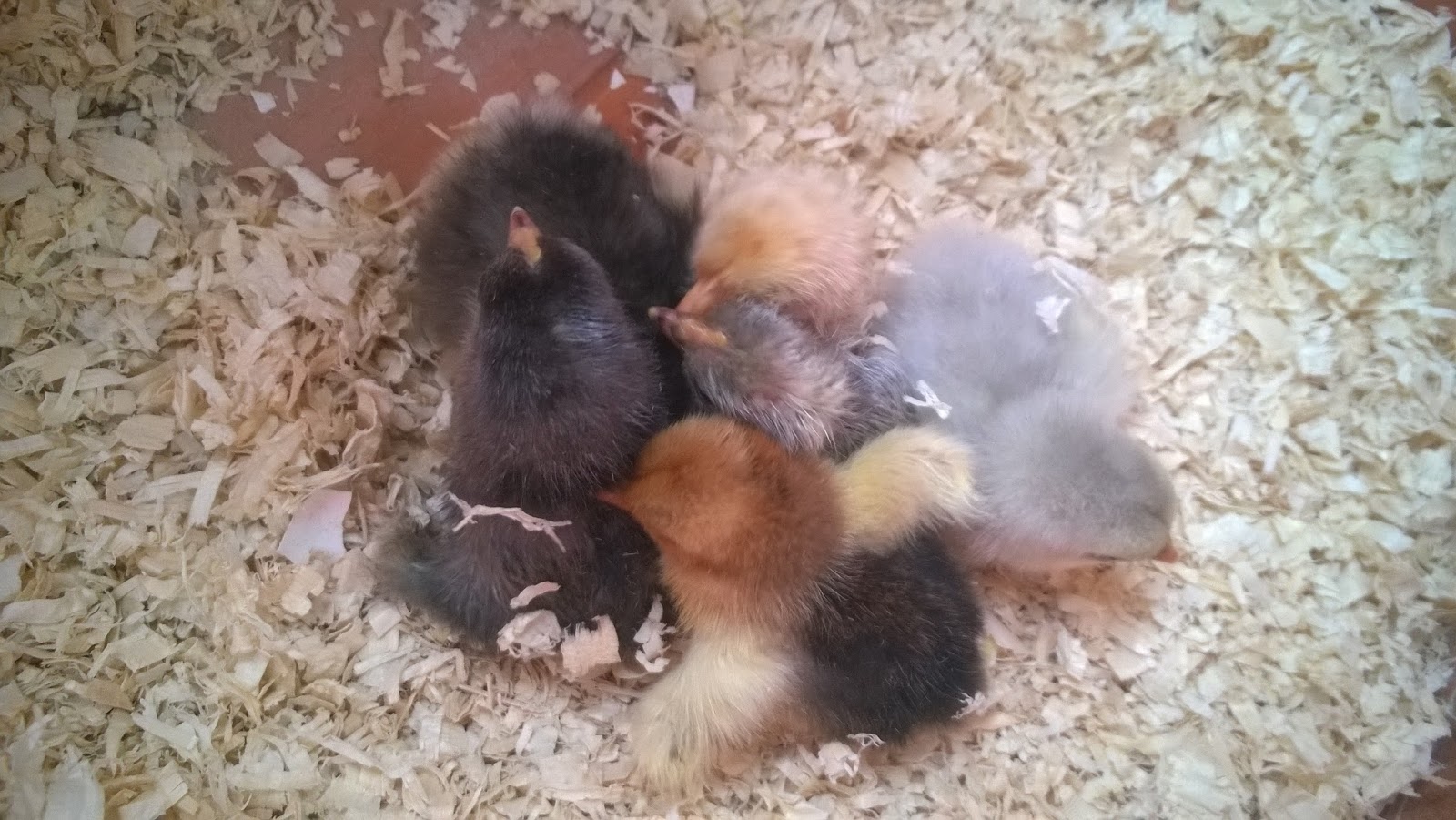
But to finish... This year I was hoping to have something of my own to celebrate on the 4th of July. I keep Pekin bantams (half sized chickens with fluffy feet), and my youngest had been asking about hatching some chicks. Now, we don't have a cockerel to get fertile eggs - we live on the edge of town with close neighbours, so the early morning crowing would be antisocial - so I ordered six hatching eggs online and put then under one of my hens who was being broody (this is when they go into a kind of trance and sit on the eggs to hatch them). They were due to hatch on the 4th. 
Nothing happened. 
On the 5th I thought I could hear tapping and scraping, but thought it might be wishful imagination but my 12yo agreed he could hear something too. By the next day we could all hear tapping and even cheeping.
The first two chicks start breaking through!


The first two eggs hatched on the evening of the 6th, with the rest hatching overnight and into the 7th. Better late than never! 
Our first two hatchlings - the darker is Splash, the silvery
one is Mot.


Our mama Effie with all her babies
(Pssst, for more videos and pics you can check out my posts at Spacefreighters Lounge HERE & HERE or follow me on Twitter as @pippajaygreen for instant and daily updates on my little fluffballs).

Tuesday, February 12, 2013

Keys to Lasting Love

Madelle Morgan
Today is my first post as a Genre-ista blogger. Thank you so much, Judith and Sarah, for the opportunity to share my thoughts with you all every month!

I write contemporary romance and romantic suspense, with one novel and a free short story published by Ellora’s Cave and several more projects “in development”. I retired from my day job as a civil engineer and manager last June, and it is so wonderful to have ample time to write and read those wonderful books I’d purchased but have been too busy to read. My husband counted over 100 books piled on my bureau alone! Fortunately it’s a very cold, stay-indoors type of winter up here in Ontario, Canada.

The topic this month is favorite romances. Well, like many avid lovers of romance I cannot pick just one. So I decided to describe three key elements of a great romance.

1. Chemistry

Chemistry comes from powerful emotional and physical attraction. Years ago Elizabeth Taylor and Richard Burton had smoldering chemistry on screen and off. Their marital splits and reconciliations made headlines. Today Kristen Stewart and Robert Pattison (Bella and Edward) are the new Liz and Richard – they have a great love that endures despite indiscretions. Or will it? That brings us to the next key element, the lack of which often drives a stake in the heart of passionate love.

2. Tolerance of Quirks and Faults

Abuse and infidelity respectively throw cold water on a steamy relationship, extinguishing it for good. On the lighter side, if a couple can adjust to each other’s annoying habits, personality quirks and faults, they have a chance of making it as a couple.

Dr. Temperance Brennan, the female lead character in the TV series Bones, likely has Asperger Syndrome or something similar in the autism spectrum of disorders. It makes her emotionally disconnected. Seeley Booth (David Boreanaz, the hunk we crushed on in Buffy and Angel), loves and accepts this beautiful but coldly rational woman despite her difficulty in being passionate and empathetic. Her logical mind, on the other hand, grounds him. Bones in turn tolerates what seems to her to be Booth’s excessively emotional behavior.

3. Opposites Attract

It’s not enough that the partners have very different personalities. In lasting relationships each person has traits that fill a lack(s) or need(s) in the other. The two personalities fit together like one of those wood 3D puzzles. Together they are whole, complete. Apart they feel like a piece is missing.

In The Big Bang Theory, the Penny and Leonard characters exemplify this crucial aspect of a great romance. Pretty, loving, living-month-to-month Penny has emotional intelligence and street smarts. Love-starved Leonard has intellectual intelligence, a stable job, and is reliable and loyal. They fill each other’s most basic needs for love and security.

What do you think is essential for an enduring romantic relationship? In honor of my first Genre-ista post and Valentine’s Day I’m giving away a print copy of my romantic suspense Diamond Lust to one commentor who lives in the US or Canada.  The deadline for comments is midnight on Sunday, February 17th!

Postscript:

Who loves diamonds? Madelle’s debut romantic suspense Diamond Lust ebook is available for only $0.99. 

Coming soon, Madelle is working on another romantic suspense novel (the story of Sophia from the free short read The Next Big Thing) and a steamy novella. 

Find Madelle at www.madellemorgan.com and on Goodreads.