Showing posts with label editing. Show all posts

Thursday, September 26, 2024

You're Never Too Old by M. Flagg

 I am aging. No doubt about that. Even though my body doesn’t always do what I want it to do without aches and pains, my mind is sharp. I thank God that medical issues haven’t altered my creative spirit. In fact, I’m writing more than ever before. In my 70s, I’ve completed six new novels: my very first YA Paranormal, four more books in my series, and one self-pub.

Not bad for someone over seventy, right? So, I feel blessed… Every day I sit at my computer ready to write. Or edit. I love to edit.

Aging is a gift. I had a wonderful career as a music teacher and as a school administrator. For me, retirement isn’t an end. It’s a beginning, another blessing that many never get to experience. To watch my children mature into fine, responsible adults. To bend with the twists and turns, the curveballs life throws at us. To experience everything with new meaning. To sometimes snicker and smile saying, “Been there. Done that. And I survived.”

I may have regrets, but I love my life. I love the freedom that comes with aging. You’re never too old to grow. You’re never too old to learn. You’re never too old to love and be loved.

My next book is out October 2nd. Night of the Crescent Moon is a sweet, paranormal romance between a good witch and a mystical warrior. And yes. I still believe that love conquers all.  


M. Flagg’s imaginative world is full of mystical warriors, witches, the not-so-normal vampires, and now, teenage ghosts. With five novels in the paranormal genre, spinning tales about the paradox of love is a passion, and there is always a twist of fate involved. Mickey is a contributor in a book on urban music education and has published a piece in Still Standing, a web-magazine about loss and healing. She is a life-long New Jersey resident, a member of Liberty States Fiction Writers, NJ Author Network and NJRW. Learn more about Mickey’s thoughts on writing and her books at  M. Flagg | Author of Paranormal Romance (mflagg-author.com)


Book Blurb:

Some wounds never heal.

Martine, a good witch and ER nurse must enlist Lukas, a mystical warrior to save her patient who is under the spell of a dark witch from the Second Realm. But she pushed Lukas out of her life years ago. When Lukas agrees to return to the realm where he was once held captive, he faces unexpected danger to bring the dark witch back to lift the spell.  Many assist Lukas, but few are trusted through his travels in a realm with ugly memories.  Will Lukas succeed in saving her patient from a fate worse than death? Will Martine open her heart, or lock Lukas out again? 

Night of the Crescent Moon – available for pre-order at Night of the Crescent Moon (The Champion Chronicles): Flagg, M: 9781509256884: Amazon.com: Books


Many thanks. Many blessings. 
Mickey Flagg 
Paranormal Fiction with a twist of fate.
Facebook page - M. Flagg

Monday, April 24, 2023

Editing and Writing


“Style means the right word. The rest matters little."—Jules Renard


“Keep a small can of WD-40 on your desk—away from any open flames—to remind yourself that if you don’t write daily, you will get rusty.”
                                                                   --George Singleton


"Half my life is an act of revision."

—John Irving


"Exercise the writing muscle every day, even if it is only a letter, notes, a title list, a character sketch, a journal entry. Writers are like dancers, like athletes. Without that exercise, the muscles seize up."

—Jane Yolen


 “The difference between the almost right word and the right word is … the difference between the lightning bug and the lightning.”

—Mark Twain

“The road to hell is paved with adverbs." =Stephen King


I hope you have enjoyed these quotes and memes on writing and editing.

Wednesday, June 8, 2022

Location, Location, Location


I envy people who get to take sabbaticals and travel, find new writing locations and landscapes that simulate those creative juices. I never get to do that.
 
When it's time for me to sit in a chair and write, it's always the same chair, in the sae room, in front of the same mirror. My view only changes with the seasons. Of course, since I live near Chicago, Illinois, those seasons can change pretty fast.  We can do spring, winter, fall and then spring again, all within twenty-four hours.   No, I didn't forget summer, but summer only appears when it is good and ready.  So, if I wanted to write a story based on the season, I would have to learn to be a speed-writer.

As if. I've been writing for over a decade now, and have yet to master that trick.  At a school presentation last week a young lady asked how long it took me to finish a book. I didn't want to say forever so I made something up, but forever is really close to accurate. I think I know every blade of grass in my lawn, even when buried under snow. I have counted and recounted them in the long years of completing five books, with my agent shopping a sixth one around right now. My chair must be so tired of me.

Ar least I did get a change of scenary on Tuesday.
    
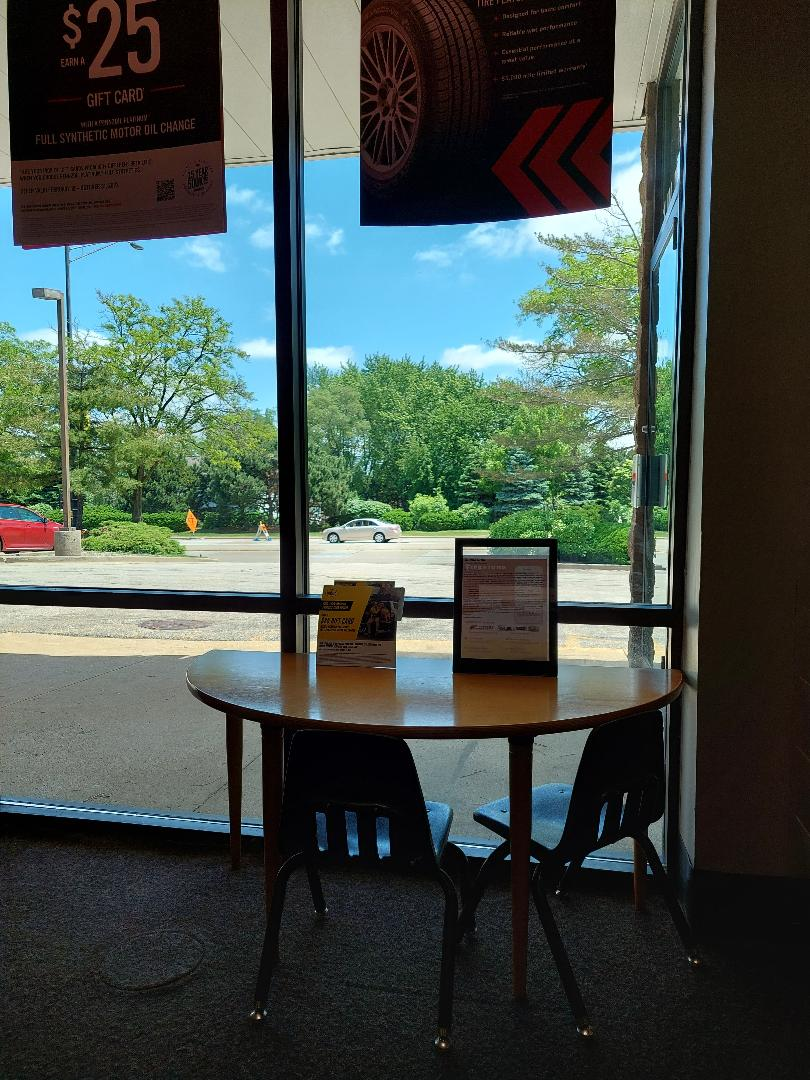
No, it was not because of a sabbatical or vacation. I spent much of yesterday perched in an uncomfortable chair looking out the window of an auto shop at the traffic. I was there because a flat tire so far gone the wheel needed to be replaced. The air was stuffy. A television blared something incomprehensible from its position mounted over my head. Not the most conducive location for creativity and story writing. 
 
However, it proved to be an awesome spot for editing. That's one part of writing I consider the most boring chore in the world. I was armed with a print copy of my WIP (Work In Progress) and one of my trusty pens. I edit best the old fashioned way, with pen and paper, not on a screen. And during two very long hours, the location ended up being conducive to updating multiplied chapters.
 
Maybe discomfort makes it easier to stay on task when faced with a distasteful job.

Who knows, maybe I will just go back there sometime and see if the place works it's magic on my editing again.

What parts of the writing process do you dislike the most?  Do you have any good tips for getting them done anyway? 

Wednesday, May 12, 2021

Thoughts on revision, and history, and life


I happen to be  at a low point right now.  Probably lower than I was this time last year, when the pandemic grew stronger almost every day with no apparent end in sight. On the plus side, I have almost no appetite. That is a really big plus. I have managed to lose ten pounds without even trying. (Just imagine what I could lose if I did try.)
 
Maybe it’s because of all the revisions I have had to work on over the last few weeks. Revision is a different animal from editing. (I did a post on the differences a little while ago.) Editing is tedious, but I can do it easily. Revision simply sucks.
 
I sent my editor at Scholastic a draft of my Non-Fiction manuscript, Unlawful Orders earlier in 2021. I say draft, even though, for some foolish reason, I considered my words nearly perfect. Seriously,  I have been writing novels - and having to revise them - for over a decade, but somehow I still foolishly believed I had crafted a revision proof draft. 

Then I received the editorial  letter.
 
The editor assured me she loved the story. Absolutely, it was awesome! There were just had one or two tiny areas she suggested I rethink. Yes, the dreaded revision letter I received for Unlawful Orders read a lot like that. I hate tiny areas. Like, even though the main character is a doctor, she thought there was too much about medicine on the pages. Oh, and there were minor characters she wanted me to make more prominent. Most of these were people who literally entered and then quickly exited the life of my protagonist. She wanted more aout World War II as well. My character lived to be in his nineties and only four years were spent in the army. Still, I needed more about the war. 

No wonder I have no appetite these days.
 
Every change to the manuscript is taking me longer than I estimated. Except deleting an entire chapter she found unnesessary. That was painful, but at least it was quick, surgical. On the positive side, my story is a historical, tracing Chicago surgeon Dr. James Williams and his family though the twentieth century. I'm back to doing research to give her the additions she wants. Sometimes going through the past is as difficult as worldbuilding a story set in some far distant planet. It also makes me think. At least the story is non-fiction. That means I know how things end.

At the same time as I hear news that San Francisco is considered a national model in Covid vaccinations, my research tells me it was a major mask denier during the Spanish Flu, making it one of America's hardest hit big cities.  The long, unending list of anti-Black riots that hit America in the twentieth century helps me understand the main chracter's father. He literally suffered a stroke when his sons were drafted in World War II and sent to Europe to fight, and possibly die, for a country that had never even passed a federal anti-lynching law. (PS, to this day, the US still has not passed one.) The more things change, the more they really do stay the same.
 
But my return to research for the revision effort did hand me one diamond. A poem called Outwitted by Dr. Roman Edwin Markham.
He drew a circle that shut me out 
Heretic, rebel, a thing to flout. 
But love and I had the wit to win 
We drew a circle that took him in.

I will keep that idea in my life (and in my story). I shall draw a bigger circle to become more accepting to the world.

Tuesday, April 7, 2020

Who wrote this drivel?!?

Many moons ago (ten years) I published my very first book, a novella, with a small press. I was sooooo excited! I’d made it! I can still remember dancing around the kitchen after receiving the acceptance email, laughing-crying, downright giddy. I could write and a person in the industry had just confirmed it! To paraphrase Ms. Fields, a publisher liked me. (My critique partners were encouraging but it’s different when praise comes from a professional editor.)

I dove into the publishing process and learned just how clueless I was. And, like many first time authors, I listened to my editor without question. She knew better, right? (She did know better about many things particularly when it came to my comma placement.)

I got the rights back to that novella late last year intending to give it a quick read-through, change location names so the story will fit in my new series, and hit publish. Wham, bam, well…ah…who wrote this lifeless drivel?!?

Now, I know my writing has changed over the years and my skills have improved (thank gods and goddesses), but my voice has remained consistent. I have journals from twenty years ago with the proof. Somehow during the editing of the novella, I got watered down.

Curious as to how it happened, I searched on my computer for earlier drafts. I discovered exactly where I messed up – and it was me, the newbie author, who did the messing. The editorial feedback had been good – tighten this paragraph, be sure to show and don’t tell, put the GMC on the page – all good stuff. My newbie self just went about fixing it in the wrong way leaving a tightly written, well-illustrated, flat piece of writing.

I’m pleased to say that editing of If I Win (new title to better fit the series) is progressing apace despite the global turmoil, and the new and improved novella will be launched next month.

And from now on I’ll compare the first, rough, messy draft of a story with the final version to ensure I haven’t “fixed” my voice out of the story.


Luanna Stewart has been creating adventures for her imaginary friends since childhood. She spends her days writing spicy contemporary romance, romantic suspense, paranormal romance, and historical romance. When not torturing her heroes and heroines, she’s in her kitchen baking something delicious. She lives in Nova Scotia with her patient husband and two spoiled cats.


Guess who’s moving in next door?

Nicole Bennett is used to bad luck—it’s kind of a family curse. She’s spent the past year stitching her life back together after losing her dream job. Well, it paid the rent. Now stuck working at her family’s grocery store while wrangling a demoralized dad and a spoiled-brat sister, the last thing she needs is for the man who wrecked her life to move in next door, even if it is for only three weeks. So what if he’s sexier than sin and makes her believe in fairy tale endings?

Ross Calvert’s life in the fast lane crashed when he lost his job and fiancée. All he’s got to show for years of hard work are a sleek sports car and a closet full of designer suits – minus the closet. Determined to salvage his relationship with his best friend, he trades in the corporate life for a brief stint as a caregiver. The decision was simple—until he discovers the tempting vixen he wronged lives next door. Maybe she’s what he needs to reboot his life.

What starts off as a no-strings fling soon veers into making promises that might be impossible to keep.

Thursday, September 26, 2019

How do I edit…as a not super systematic pantser?

By Cassandra O'Leary


How do I edit as a panster? I'm glad you asked, dear readers. I'm currently in the final throes of editing a single title romantic comedy manuscript (currently 96,000 words long) and it's been a saga. For starters, I began writing this novel in 2015, then left it halfway done for at least a year before finishing the first, messy draft. Then I sat on it again for about another two years! Note, I do not recommend this method...I only remembered the bare bones of the plot by the time I got back to it.

But a lot happened in the intervening time. I got my first book published with HarperCollins UK (not my first manuscript though, that's also put away and will never see the light of day), I wrote some shorts and novellas and nearly an entirely different book. So I guess I've learned a little since then.

From the first draft to something book-like

Coming back to the draft, I was pleasantly surprised it didn’t completely suck. There were some interesting characters (hello, I remember you!), funny dialogue and a setting that I think it a bit different. Then I struck the problems, and oh boy, they were many. Missing scenes and chapters out of sequence were the main issues, and honestly they’re a hallmark of my writing because I’m a real panster (I write by the seat of my pants, without an outline). I often open up brand new documents to write single scenes when I feel the urge, or when I get stuck. Then, I have to work out where to slot-in the new content, and smooth out the rough edges so it matches the preceeding and succeeding scenes.

I’ve re-jigged the structure of this manuscript quite a lot, so it’s book-shaped, has chapters that are roughly the same length, alternating point of view scenes, and hopefully with chapter endings that have a hook or at least an interesting last line.

Continuity—or where did that character go?

So, continuity is the first thing I look for. My heroine was apparently getting test results from the doctor before she even made an appointment! Also, I look at how my characters’ dialogue has changed—I notice if I’ve added in more slang or different speech patterns as I go along. This is me as a writer, getting to know a character’s voice. Then there is the problem with disappearing secondary characters. I’m just thinking of writing a new scene with my hero and his best friend, because poor Sam the mechanic was only in one scene, and has apparently evaporated.

Nuts and bolts

Next comes nuts and bolts stuff like fixing spelling errors, missing words, excessive use of some words (that, but, just, only—these are my worst offenders as repetitive words) and short sentences versus longer. I tend to write sentence fragments and direct thoughts as a character would speak them. This is a stylistic choice and not an error as such, but it can become annoying if the same type of sentence is repeated e.g. Oh. My. God. I have a character that would say this, but we don’t want it ten times on the same page! I’ll do another check for all of these things when I get to the final draft.

A special note on sexy scenes

I like the sexy times on the page…too much maybe. My sex scenes tend to be overly long in a first draft, as I get them out in a big, long, hard, marathon session (I love double entendres, LOL). This means, analysing a sexy scene like I would any other scene—where is the pace too slow, where is it all action, no emotion, or where is it out of character or lopsided, from only one character’s point of view (when writing in both main character’s POV).

If it’s all he-did-this-to-her, then he-did-this, it’s a little boring. And because I write romantic comedy, I like to add a little humour in the bedroom (or car, or office or whatever) when the characters get together. Maybe the heroine blurts out something completely inappropriate at a vital moment… This is where I also examine dialogue to see if it’s doing its job in the scene.

Hard copy for a close-up look

Once I have a second draft that mostly hangs together, it’s time for me to print out the manuscript in its entirety and mark-up edits on the printed page. Time for red pens and highlighters! This helps me see outstanding issues with repetition, the balance of dialogue versus narration on the page, plus I tend to notice stand-out expressions in print.

I recently attended a writing workshop with the fabulous author, Stefanie London, and she reminded me about something I’d learned a couple of years ago. Each author has their own literary techniques that they can amplify in editing e.g. alliteration. I LOVE ALLITERATION! Sexy, sensational scenes start slow…you see what I did there. The repeated ‘s’ sound gives a poetic sound to the line. I naturally write some lines like this, but it’s worth spotting and improving these patterns in edits.
Once I’ve marked up all of these handwritten notes, I edit the main document on my laptop again. We’re nearly there!

Finally, the read through

A great idea I picked up from a friend, is to send your completed manuscript to your e-reader or tablet, and read it like a published ebook. Don’t edit on screen, but keep a notepad handy to write down any issues you notice as you read. Hopefully by this stage it’s only minor typos that slip through, a quick fix rather than a major re-work.

The End! Except, now it might be time to write a query letter or synopsis…urgh.

About Cassandra O’Leary

Cassandra O'Leary is a romance and women's fiction author, communications specialist, avid reader, film and TV fangirl and admirer of pretty, shiny things.

In 2015, Cassandra won the We Heart New Talent contest run by Avon Books/HarperCollins UK. Her debut novel, Girl on a Plane, was published in July 2016 and in translation in the Czech Republic as “Letuska”. Cassandra was also a 2015 finalist in the Lone Star writing contest, Northwest Houston Romance Writers of America, and a 2014 finalist in the First Kiss contest, Romance Writers of Australia. In addition to her traditionally published work, Cassandra has indie published novellas including Heart Note: A Christmas romcom novella, and short stories.


Cassandra is a mother of two gorgeous, high-energy mini ninjas and wife to a spunky superhero. Living in Melbourne, Australia, she's also travelled the world. If you want to send her to Italy or Spain on any food or wine tasting 'research' trips, that would be splendiferous.

Read more at cassandraolearyauthor.com


Saturday, September 7, 2019

“Editing Doesn’t Matter!” by Developmental Editor Jessa Slade


With the self-publishing market matured and the early “easy money gold rush” days contracted, I’ve been seeing more posts in online author groups about belt-tightening and ways to minimize overhead in order to maximize profit. This is a valid concern for small business people, which is what self-published authors are.

Toward that end, some authors have turned to a churn ’em and burn ’em book production schedule of faster, shorter, and cheaper books. To keep the volume high and the costs low, one of the suggestions sometimes made to such writers is to ditch editing.

To which I, a freelance editor, say—do it!

…If you can.

As an editor, I adore clean copy and beautiful, powerful prose. But as an author, I know that STORY is the One True God.* Everything else exists in service to the story. Cover art, blurb, marketing—none of that matters as much as the story itself. Editing doesn’t matter either…except where not editing gets in the way of the reader’s eager consumption and enjoyment of the story.

So, if you are a newer writer or a more experienced writer making adjustments in a changing marketplace, how do you decide if editing matters to you?

If you are in command of your plot and characters and can objectively review the last draft for its strengths and flaws, you might not need a content or developmental editor. (Although you might if you are pushing yourself to the next level.)

If your grasp of grammar, syntax, tenses, spelling, punctuation, and a thousand other nitpicky points of writing is professorial—not to say perfect—you might not need a line editor or copyeditor. (Although you might if your writing speed or focus would be improved by not nitpicking.)

If you can search’n’destroy every typo… Well, you’re fooling yourself. J Everyone needs a proofreader.*

Editing isn’t a necessary evil. It’s not a rite of passage for a newbie, to be escaped asap. It’s not even a way for editors to pay rent. (Okay, it is partly that!) The purpose of editing is to smooth a path from the author’s intent to the reader’s interpretation so that the story shines as clearly as possible between you.

For writers who want to self-edit—whether to try to save money or to sharpen their storytelling craft—I’ve put together an editing highlights reel. These are the elements of editing that I consider most important and that writers seem to struggle with most often. This covers the three stages of editing: 1. big-picture developmental or content editing, 2. mid-level line editing or copyediting, and 3. polishing or proofreading. This is not a complete list, and if it still seems like a lot…well, it is a lot!

And that’s why some writers work with editors. J

Self-Editing Checklist from Red Circle Ink

Let yourself forget the story and come at it cold.
Rewrite the cinematic tagline of your story as you know it now.
Re-read your story as a first-time reader, keeping the revised tagline in mind.

Start with big-picture re-visioning of conflict, character, and cadence:
Conflict evaluation: Is you plot (i.e. stakes and consequences)…
Clear
Instantly relatable
Deeply personal
Compellingly dramatized
Escalating to a satisfying conclusion
Character evaluation:
            Core personality (relatable and interesting)
            Goal, motivation, and conflict
            Character issue (wound)
Fear (holding back, driving forward)
Purpose (want vs. need)
Growth arc (sequential steps of change)
Moments of change (linked to plot)
Cadence evaluation: (pacing)
            Master scene list with rising tension
            Gray pages
            Varied length (of chapters, scenes, paragraphs, sentences, even individual words)

Refine mid-level issues: Do you have clear and compelling…
            …Emotion—Have you moved the reader?
            …Point of view (the characters’ and yours)
            …Worldbuilding (fresh, coherent, and evocative)
            …Setting and timing (continuity)
            …Theme

Polish line-level issues including:
Create unique character voices with character-specific imagery
Evoke a sensory experience with the full range of senses
Limit filter words that put the reader at a distance
Leverage power positions (beginnings and ends)
Punch up dialogue and internal monologue

Tackle word-level copyediting after everything else is “perfect”
Amplify power words—strong verbs, specific nouns, evocative adjectives
Avoid clichés
Be aware of your darlings

Proofreading: “Last” pass
Change the font. Print it out. Read backward. Read aloud. Have your computer read to you.

The one rule*:
Be compelling. The story matters most. All editing serves the flow of story.

You can find the one-page Red Circle Ink Self-Editing Checklist here:
https://redcircleink.com/writing-and-editing-philosophy/one-page-self-editing-checklist/

* Anytime I write in absolutes, please just assume we all know That One Exception. If you are that exception, how nice for you!

***


Jessa Slade writes paranormal romance and science fiction romance as Elsa Jade. She launched Red Circle Ink developmental editing services in 2013 as another outlet for her love of story and to better understand what works in storytelling and why—as impossible as that may be! Since then, she’s worked with dozens of authors in many genres and won awards for editing. Please note that she does not always practice what she preaches, and as always with writing advice, YMMV.

Wednesday, August 9, 2017

Preserving your Voice


Hi everyone! I am YA author B A Binns , writer of contemporary and realistic fiction for teens. My tagline tells you what I am about - Stories of Real Boys Growing Into Real Men - and the people who love them. 


This is my second post on that super-elusive quality called Voice. The first post (which you can find at VOICE: It's All About You) came back in March, fittingly occurring as I was beginning the first of what ended up being three different rounds of revisions for my debut middle grade novel, Courage. I craft stories for kids. I am not one of those prolific writers who can curn out multiple books every year.  My first YA novel was published by Westside Books in 2010. Courage, which will be released in 2018 from Harper Collins, is only my fourth published novel. In between I have written several short stories and have two stories in progress.  Like a chisel wielding stone artisan, I work slowly, clawing out a finished product one chip at a time. At least my chosen media is slightly more forgiving than rock. When I mess up, I get to delete and rewrite with a keyboard.

For me, crafting a novel means doing that over and over again. The roughest part for me is figuring out how to perform major revisions without loosing my initial vision, my Voice.

Voice is hard to describe, but it’s something you just know when you hear it. Think of music. Christmas approaches (I know, I can barely believe how much of this year has gone myself).  Various artists will be releasing their versions of the old standards. Same old words, same old story, but different people find different artists compelling, singing standards that stand out because of the arrangement; the Voice.

I ponder this because I came face to face with the issue over the last few months while doing final revisions for Courage. As I said in another prior post, Revision and Editing are not the same things. Revision can involve making major changes to improve the story and reading experience. Those changes can encompass everything. Everything except dismantling the novel's basic core and theme. That has to remain to keep the voice intact.

At its core, Courage is about brotherly love and is a retelling of the Prodigal Son parable told from the point of view of the good brother who now fears the older brother he once loved and revered. I typed The End on this story in 2015. It was acquired by Harper Collins in 2016. Revisions began earlier this year for the 2018 release. Let me say that my editor is a wonderful woman. She’s interesting, loves books, and has near infinite patience. She also saw parts of the story she really wanted changed. I had to both listen to her, and remain true to the theme that moved me.

However, over the years, my own voice had changed. The 2016 elections played a large part in that, along with many of the issues plaguing people of color in America, including children of color. As I did the revisions, I realized there was no way that could not leech into my story. I was amazed to find how the personalities of several characters changed as I plowed through the revisions. But the innermost story of redemption remained strong.

As I said in my prior post on Voice, an author’s voice is the sum of their life experiences. That is the thing editors and agents prize more than they do the author’s plot. Lots has happened to me, my life and my world in the last two years. When called on by my editor to rework the ending, my updated Voice licked it’s lips and took control.

Our writer’s voice constantly evolves. That sometimes has us looking back on our body of work done years earlier and being astounded. We evolve, change, come up with things that are different because we ourselves evolve. Remember that when dealing with critique partners, beta readers, and editors. I’ve heard of writers revising to please them until their once vibrant and lively story turns voiceless. No editor or agent I know is interested in a story without a compelling, leap off the page and suck readers in, Voice.  It is Voice that makes writers. As someone said, there are only so many plots in the world. What makes a story original, what makes it yours instead of someone else’s, is how Your Voice tells Your Story.

On a related note: a number of editors, agents and award-winning authors are giving away critiques as a way to help the new a new organization, KIDLITNATION.com. Kidlitnation will use the funds to help #ownvoices. be heard. Today, August 9, is the final day of the raffle, if you are interested, take a look at the array of talent you can bid on at http://kidlitnation.com/home/own-your-voice/fundraising/. This is a chance to get feedback from industry experts on your Voice and your manuscript.

Thursday, February 23, 2017

Silencing Your Inner Editor

I often struggle with silencing my internal editor. The little voice that provides a running commentary on everything I’m doing wrong with my writing. Of course, that little voice can be helpful in small, controlled doses when I’ve transferred my ideas to the page and am ready to refine them. But during the creative process, all it does is feed my doubts and block creativity until my characters stop talking to me.


Ever stared at a blank screen, the cursor taunting you with its incessant blinking, and felt paralyzed? What is so scary about that blank page? Often we have more ideas than time to work on them, so why can it be so difficult to get them from head to paper (or computer)? For me, it’s the fear of failure. The ideas seem so perfect in my head, and I want to do them justice, so I put a lot of pressure of myself. Now, when this happens I simply remind myself of the following advice that many writers would have heard time and again.

‘You can fix a bad page, but you can’t fix a blank one’

We waste a lot of energy talking ourselves out of writing because it might not be perfect. Why not refocus that energy into putting words to paper as they come. We can go back and ‘fix’ anything we’re not happy with later.

These fears can often continue throughout the writing process. Rather than taking off with an idea and letting the words flow onto the page, I find myself critiquing each paragraph, sentence or word, as I go along. I’ve even been known to stop mid-sentence searching for the ‘perfect’ word to describe something as inane as the color of the dirt on a character’s shoe.  Thankfully, I’ve been able to work on that bad habit, and rather than dwelling on something so small, I will move on, or alternatively, place a small note to come back to during the editing stage.

It’s important to remember that a first draft isn’t meant to be perfect. It’s a way to let your creativity flow; to find your voice and let your ideas run wild. Once you’ve let all of that creativity out and have something to build on, you can go back and edit.

The next trick is being kind to yourself. Your inner critic will judge you and tear you apart... but if you find something you’ve written is just ‘rubbish’, have a laugh and try again. I’m sure even the most successful writers out there have cringe-worthy moments when reading over their initial drafts. It’s all part of the process.

Here are some tips to help you turn off that internal editor:

No editing: Put a ban on editing of any kind. This can be as simple as not being allowed to read over what you’ve written, or to be even more extreme, stop yourself from using the ‘backspace’ button at all. If you’ve made a typo it can be fixed later.

Set goals: Even if you have limited writing time, aim high. This is the idea behind the popular NaNoWriMo (National Novel Writing Month). Participants need to complete 50,000 words in one month. It’s a big ask, and meeting that goal requires non-stop writing during precious writing time. For most people there’s no time to edit, therefore the words, and creativity, flows. 

Use a productivity app: Programs such as ‘Write or Die’ where you can set goals around word counts or time limits are extremely helpful. 

If you couldn’t possibly fathom writing an entire story without editing, then restrict it to one chapter at a time, or if that still causes heart palpitations, cut that back to one scene. C’mon, I know you can get through one scene without editing!

Many of these apps will also stop you from accessing the internet for a set amount of time - no more being distracted by social media.

Plan: This will be hard for my fellow ‘pantsers’, but it’s worth trying. Have a rough plan for your story. Sometimes, the more detailed, the better. I find if I have scenes planned out at certain points of the story, even if it’s just the overall objective of a scene (e.g. Show the development of trust between hero and heroine), it helps keep momentum. Stalling, or becoming ‘blocked’, is like holding up a ‘welcome’ sign to my internal editor. I must keep moving.

Note: Pantser = A novelist who writes by the Seat of their Pants, not taking time to plot the novel before beginning to write.

Try something different: If your self-control has disappeared and you absolutely cannot stop yourself from editing, it’s time to turn off the computer and try something else. Why not grab a pen and paper? Rewriting and amending the same sentence ten times suddenly becomes more difficult. Another alternative is to dictate your story. You don’t even need a Dictaphone. Most smart phones have a voice record/memo facility. Just hit record and start talking. No editing here. That can wait for when you transcribe it all later.

Hopefully some of these tips will help you let go of the fear and set your creativity free.

Lauren James is a country girl at heart. Raised on a small property surrounded by animals, it's no surprise she writes small town romance with lots of love for creatures great and small.

Having failed fabulously at painting, sewing and playing guitar, she finally found her creative outlet in writing strong, quirky heroines, and tough, handsome heroes with gooey animal-loving centers.

Lauren lives on the outskirts of Melbourne, Australia, with her beloved rescue greyhound, Daisy.

You can contact Lauren via her websiteFacebook or Twitter.

Thursday, August 20, 2015

Your writing doesn't have to be perfect, but it should at least be close.


Happy Thursday Everyone! Thanks for stopping by. I’m Terri Molina, and I write Tex-Mex romance. You can learn more about me (should you choose) at www.terrimolina.com


I understand, more than anyone, no writer is going to have a perfect draft. There will always be edits for grammar or punctuation. However....it doesn't mean you should toss your manuscript "out there" and hope no one notices or cares that you misplaced all your commas, or even used too many.

Way back when I first started writing, I joined an online group that was having a contest where you could post a chapter of your work and everyone could comment and judge….like American Idol only with writers. There was an entry I felt needed a major edit and I commented about it, mentioning the too-much-telling and overuse of adverbs and someone (who's work I didn’t have a glowing response to) posted this comment in regards to my critique:
Yes, we all know that there will be revisions and more editing; however sometimes we need to look past that and just read the story.

Uh....No. Agents and editors aren't going to look past bad writing so they can find out where your story is going. If you can't grab them in the first few pages your story is history....it doesn't matter if it's the best thing since microwave popcorn!

Now, I read close to a hundred of the entries because for some crazy reason people wanted me to....their reasoning being, they want to learn and I'm known as the resident Hard ass where my comments are concerned and I tend to give detailed feedback (when I can), without sugar-coating. I didn't set out to get such a reputation, but I do know, if you can't take it from me (when I'm trying to help) how are you going to take it from an agent or editor??

I’ve learned a lot in the ten-plus years I’ve been writing, and I continue to learn, refreshing my craft with workshops or books or judging writing contests and just working with other authors.
Anyway, since we’re giving advice this month, I’m throwing in my ten cents worth. My advice to new writers is based on contest entries I’ve read and what I felt the writer could improve on.  So….put on your hardhat, debris may fly. haha

First of all, to those who chose to write in first person...and for some reason, thriller and/or crime fiction newbies seem to think they're supposed to...I suggest, unless you've read works by the pros who know how to write first person exceptionally (i.e.; Lee Child, Robert Crais, Rick Rhiordan, Joe Konrath)...don't try it at home.

The mistakes I see a lot of new writers make with first person are 
they tend to spend too much time in the narrator's head, explaining the who's and why's of everything until it becomes monotonous to read. Granted, with first person your main character is telling you the story....but the reader doesn't need to know the background of every single thing that affected the character's life....because it's really not that important to the scene at hand (and anything relevant can be woven in as secondary characters are introduced. But at a minimum. Less is more.)  For instance, telling us: John met Jane twenty years ago at the vet when they were waiting for the free rabies shots given each year and the dogs fell in love so it was natural they would too but it didn't quite work out because...blah blah blah! None of that has anything to do with who the character is as a person or why the reader should relate to him/her. All it's doing is taking the reader out of the story. And once you do that...you've lost your reader because (unless they're related to you) they aren't going to want to go back and read to figure out what the heck you're talking about.

With first person, you have to tell the minute details as they are happening to you (the MC) because you want the reader to have the same pieces of the puzzle so they can also try to figure out who-dun-it...assuming it's a mystery you're writing...but regardless, with first person, you don't want the reader a step ahead of the character.

Below are my Do’s & Don’ts for writing scenes.

First and foremost, Do make sure the scene you're writing is necessary to the plot.
Don't throw in a description of the scenery for the sake of trying to tell the reader you character is now standing on top of a mountain. In other words don't open with a panoramic view of your setting just to introduce your character sitting in his study smoking a pipe by the fire.
Don't give a history lesson on your setting (like saying when the town was founded, or who founded it, unless it plays an important part in the story.)
Don't overdo your prose by using too much descriptive narrative or exposition-such as going through the minute details of the character's everyday mundane life (she went home, made a cup of tea, put on some opera and went to bed--y a w n.)
Don't do a prologue (a majority of agents and editors really hate them!)
And please Don't open in present day with something exciting happening, then jump back in time to explain how the character came to that part. It's not only annoying, it's intrusive. When you do that you're basically doing this:
... Jane waited at the crosswalk for the hand signal to turn white. As she stepped off the curb the street began to vibrate. She barely had time to register the danger before the truck rammed into her. She flew through the air, her last thoughts of Jacob as she landed with a heavy thud against the concrete.
But, wait....let me tell you what happened before this....
Don't describe your characters through their own eyes, build them through someone else's eyes. (meaning, when you're in Jane's pov she could describe John's traits...and so on)
Don't start sentences with THEN, FINALLY, SUDDENLY (because nothing ever really happens suddenly).
Don't use too many AND's or THAT's...you don't want your sentences reading like a grocery list of action.
Don't use any of the following words or variation of these words--see, hear, feel, taste, smell---to explain what the characters saw, heard, felt, tasted, or smelled...SHOW it.
Don't introduce too many characters in one scene. If each of the characters are integral to the story, introduce them in their own chapter and in a way that shows how they're affected by the incidents that have happened so far (meaning, how are their lives changed by what happens) And again, don't give the everyday mundane actions they go through each day.

For any novel (regardless of genre), something has to happen immediately. Usually something life-changing for the main character. You cannot spend the first ten pages introducing a character and giving us his/her life story (as it was or is now) because you will bore the reader (especially this reader). Just give the minimal facts that are relative to the character (who s/he is/what's his/her job/what type of personality s/he has) and weave the rest in as you go to further develop him/her...but do it in a way that isn't TELLING. In other words, don't say, John is a cop. Instead, show what makes him a cop....maybe open with him at work. Don't say Jane has a soft heart for stray animals, instead show her sneaking a can of tuna fish from her mother's cabinet and leaving it in the bushes for the cat that's been prowling around at night.

When writing your dialogue try writing it as you speak (unless you're writing historical or period pieces of course.) Don't have your characters constantly say each other's names when speaking to them.
"Hi Jane."
"Hi David."
"How was your night, Jane?"
"It was fine, David. I went to a movie."
"That's nice, Jane. What did you see?"
"Well David, I don't remember because I fell asleep."
Annoying huh.

Another thing to look out for in dialogue are your tags. If your writing strong dialogue, it isn't necessary to use a tag to identify how the character is speaking. You don't need to say..."They're coming back," she proclaimed! The dialogue and the previous action should convey the emotion in the character's voice.

When starting a novel, figure out who your main character is and write from their POV. Show everything through their eyes as they see it unfolding. Otherwise, your story will read like an article in a magazine with no real emotional connection for the reader. And, don't talk at your reader. As a reader, I want to be pulled into the story, I want my emotions challenged...not my intelligence (which is what I mean by talking at me like you're trying to explain everything.) You don't need to hold the reader's hand. As Dave King states in his book SELF-EDITING FOR THE FICTION WRITER, resist the urge to explain! Because, really, if you have to explain the who's and why's of your story...then you're not doing your job.

Here are a few more tips from the comments I made on entries in regard to what to look out for when writing.

Don't put thoughts in quotes. Quotes are for actual speaking dialogue only. Thoughts should be in italics.
Don't use adverbs when a stronger verb will work.
She pleadingly looked around the empty city
How do you look pleadingly? Show it better.
She searched the empty streets, her heart pounding, searching for someone, anyone who would help her.
Watch out for too literal descriptions (sometimes referred to as flying body parts...rolled her eyes; threw up her hands, etc)
Don't start your story with a dream if you can avoid it because it can piss off a reader. It's like a tease. They think something exciting is happening only to find out it's a dream.

Image result for read everything
And one more very important thing: READ! Read everything...fiction, non-fiction, graffiti on the bathroom wall...(heh...just kidding..unless it's really good. ;-)) The point is, if you don't read, you can't learn.

A few more things to look out for when you're writing: (and some is repetitive, I know)

Passive voice.
Sentences starting with AS.
Sentences that read like a grocery list (this, AND this, AND this, happened....you know?) Watch out for too much exposition--meaning too much back story too soon (or worse, going into back story to explain what happened previously)
Show don't tell ...in other words, don't use the words: saw/heard/felt/smelled/tasted as descriptive words.
Give the reader the benefit of the doubt to know what you mean. For instance, don't tell them someone closed the door after they opened it. In other words, don't hold the reader's hand.
Another no-no with exposition is putting it all in dialogue.
"Lettie, we’ve been together five years. Leave John and come away with me."
" You know I can't do that. I own him. He is the one who made it possible for me to attend law school. Before he showed up I had to work long weekend shifts. I was almost ready to give up the crazy idea of becoming a lawyer while working as a stripper so that I could give my mother and Johnny a decent place to live. Now John is about to go to college and Mom doesn't have to work so hard as a maid in order to pay for everything because her arthritis is so bad."
"Yes, I know. I lived it with you."
This is called info dump through dialogue. Never have one character say something to another character that they already know. If any of this is important, feed it in later.

Another thing I've noticed is sometimes writers will chose to use their first chapter as an introduction to the story, then tell the reader, "but wait, the second chapter will explain everything." Well, I'm sorry but I have to reiterate...unless you grab the reader in the first few pages of the first chapter they aren't going to bother looking for the next chapter!

Okay....I think I’ve babbled long enough. I hope those of you who made it to the end have found something useful to consider when going back to your work.


Regardless....I wish you only the best in you endeavors.