Showing posts with label #1940s heroines. Show all posts

Tuesday, February 14, 2023

Wartime Friendships by Eleri Grace

 Our theme of relationships this month -- as it so often does each February -- brought me up short. I'm divorced and haven't even been on a date since before the pandemic. Sure, I could focus this blog on non-romantic relationships -- my relationships with my young adult children, with my wide circles of friends, with the larger writing community, and on and on. But I was not particularly inspired, nor sure how to tie those potential angles in with my writing. 

So I'm revisiting a theme from several years ago in February and putting a slightly new twist on it. In that blog, my focus was on how my Red Cross Girl heroines marched to the beat of a different drummer than their contemporaries in so many respects and how I, as a writer, have created novels that don't fully follow the standard tropes of historical romances or historical mainstream fiction. 

The Red Cross recruited extraordinary and accomplished women for overseas assignments. Marked not only by higher education and far more professional experience than most women of that era possessed, the Red Cross recruits possessed some or all of the following attributes in some measure: poise, charm, conversational skills, self-assurance, independence, ingenuity, adaptability, stamina, and creativity. Even in the earliest days of WWII, the Red Cross realized they needed self-starters who could draw on a range of varied life experiences to do unprecedented work. 

Because they were all so exceptional and at least somewhat out of step with the times, Red Cross Girls formed very strong bonds with one another. Fast friendships formed -- in the weeks of training stateside, on the voyage overseas or on location. One Red Cross Girl writing back to her training instructors from Europe noted: "Some fellas think we're brave, but we really don't know enough to be scared. Some think we'd be better off at home, where a woman's place used to be . . . about 200 years ago." I think most of us probably find it astonishing that a 1940s woman viewed the housewife trope to be an outdated norm. For some of these women, the war presented them with yet another opportunity to break free of strictures imposed back home. Based on many of the memoirs these amazing women wrote later in life, many of them went on to start or continue a successful career outside the home, whether they married or remained single. 

Yet, it took no small amount of courage to take such a leap of faith in signing on for destination unknown, duration unknown, and dangers unknown. The women frequently didn't know where they were assigned until they were out at sea (although they could make educated guesses based on whether they were shipping out from the east coast or the west coast). They didn't have a crystal ball to know the war would end in 1945. Most importantly, they had no idea what they would be called on to do or face in the course of their duties for the Red Cross, though most were smart enough to assume it would involve a lot more than serving coffee and doughnuts! 

Their unique qualities didn't shield them entirely from fear or from experiencing profound anxiety, stress, and war-weary despair. And in those times, they leaned on one another. The Red Cross friendships forged in wartime continued on after the war in many cases, with the women often remaining in touch for decades after their service. And like their male combat soldier counterparts, the women recalled their wartime service as the most significant years of their lives. The relationships they formed during those years, whether they continued on after the war or not, left their mark in so many important ways. 

You can find my Clubmobile Girls novels on Amazon, and you can learn more about me and my writing on my website or through my social media accounts on Facebook, Twitter, Instagram, and Pinterest. 


Tuesday, August 11, 2020

Lions and Tigers and Bears, Oh My!


Well, given the locale of my third Clubmobile Girls novel, my heroine might more readily exclaim: “Cobras and Tigers and Elephants, oh my!”
Yes, we are headed to exotic and mystical India in my next WWII romance novel. Many readers won’t remember that Americans fought and died in India during WWII (or why), so I’m composing a prefatory note to set the stage. Trying to distill the high points into a succinct summary has impressed on me just how complex a situation my hero and heroine will face. Nationalist protests, riots and strikes roil the country during these waning days of the British Raj, famine results in suffering and starvation on a mass scale in large swathes of the country, intrigue abounds as the Indians, British, American, and Chinese jockey to advance their favored military and post-war strategic interests, guerrilla forces battle the enemy and the environment in the steamy jungles of Burma and northeast India, and Hump pilots making daily trips over the Himalayas in the worst airspace on earth face untold hazards to keep China supplied with vital food and military supplies.

My heroine is delighted and enthralled from the moment she catches sight of Bombay from the harbor. India is as far away from her small hometown in Missouri and her troubled past as it is possible to imagine. And while she initially focuses on the potential for adventure and a fresh start, she must all too quickly confront a myriad of challenges to her worldview of India and to her goals and plans.


By contrast, my hero wants nothing more than to escape India at the earliest possible opportunity. A son of American missionaries to Burma who attended boarding school in northwest India, he is anxious to return to America and his future in the ivy-covered halls of academia. He had, after all, already done his part for the war, flying combat missions with the Flying Tigers in the earliest months of the war. But escaping the lure of this labyrinthine land he had called home most of his life, not to mention a call of duty he is uniquely qualified to offer, proves difficult. The bright and brave young woman he cannot evict from his heart complicates things all the more.
            I would love to say that this more sequestered and slower paced life I’ve been leading has translated into huge daily word counts. Alas, that has not been the case. But I am nearing the end of my research process, have a good solid start in the early chapters, and have committed to start meeting that 1000-1500 word count daily goal again this week. I know I’m not the only author who has had difficulty with overall focus and productive habits in these challenging times. And the research required to corral the myriad competing potential plot points for this vast and complex setting has been an enormous undertaking. So that’s a long way of saying I am trying to give myself permission and space to let this story bloom gradually, rather than second-guessing whether I ought to have more to show for such an extended period of being largely housebound!  
I hope all of you continue to take care of yourself and your loved ones and stay in good spirits as we continue to adjust to a new normal.

You can learn more about me and my novels on my website, and you can also find me on Facebook, Twitter, Pinterest, and Instagram. 

You can purchase my first two Clubmobile Girls novels on Amazon.


Tuesday, May 12, 2020

Accentuate the Positive by Eleri Grace


Celebration – celebrating yourself in particular – is our theme this month. Like Luanna blogged last week, I tend to indulge in rewards or treats when I reach goals I set for myself or achieve a special milestone, but as she notes, I’ve not really thought about it as celebrating myself so much as celebrating the achievement. Perhaps I really should try harder to give myself credit – get out of the “box-checker” mentality to borrow a phrase from Michelle Obama’s memoir and instead focus more on cultivating self-love.
One facet of finding self-love is practicing mindfulness – being fully present and not in a constant state of reaction and over-reaction to what’s going on around us. Heightened awareness of life’s small joys is one of the many blessings I’ve counted during these pandemic times.
Goals and milestones don’t have to be momentous or consequential to merit a celebration – a distinction that is more important than ever right now. I know I’m not the only writer or creative type struggling to find creativity within the chaos around us these days. But instead of berating myself for not using this time to storyboard or brainstorm my next novel, I’m trying to focus on what I am accomplishing rather than what I’ve not done.

I may not have plotted the next Clubmobile Girls novel, but I have done quite a bit of background reading. That novel is percolating, and its characters will burst to life any time now.
I may not have used this time to get into the habit of posting new and enticing content on my social media accounts on a regular basis, but I have done an online class relating to author advertising that I think will improve my ability to promote my new release later this month.
It’s worth celebrating the small things every bit as much as life’s larger moments. A positive mindset is one powerful tool toward truly experiencing gratitude, self-love, and living more fully. It's a habit I hope I will have cultivated enough to carry forward once we return to "normalcy" or more aptly the "new normalcy," whatever that may look like.
 As Johnny Mercer sang so memorably in 1944:

You’ve got to accentuate the positive
Eliminate the negative
And latch on to the affirmative
Don’t mess with Mister In-Between

And speaking of accentuating the positive, I have a new release coming out on May 22nd -- just in time for Memorial Day weekend. Pre-orders for the ebook version are live on Amazon here.


In love, as in war, truth can be the greatest casualty.

When her New Orleans editor refuses to grant war correspondent credentials to a woman reporter, Hadley Claverie finds another route to the front lines: overseas duty with the Red Cross. She wants nothing more than to carve out a career as a respected journalist, but a sexy pilot set on playing by the rules undermines her determination to expose truths about the war, no matter the cost.

Struggling to overcome emotional trauma linked to Pearl Harbor, once-freewheeling B-25 bomber pilot Skip Masterson longs to prove he is worthy to carry on his brother’s legacy. Duty compels him to avenge the horrors his brother and friends suffered aboard the U.S.S. Arizona, but all Skip really wants is peace on a quiet porch back home. His heart has other plans, in the form of an intrepidly curious Red Cross girl who threatens his resolve to fly straight and subvert his hell-raising past.

As Allied forces wrest control of the Pacific, one island at a time, and the military taps skilled pilots for a highly-classified and unprecedented bombing mission from which Skip may not return, Hadley’s journalistic fire places her squarely in an ethical drop zone where truth harms, secrets protect, and love just might be the most harmful weapon of all.

From the sunny beaches of Australia to the lush and oppressive jungles of New Guinea, Carry a Crusading Spirit is a sexy and thrilling continuation of Clubmobile Girls, a series that champions the trailblazing role of women in WWII.


Learn more about me and my writing on my website, and you can also find me on Facebook, Twitter, Pinterest, and Instagram. 

You can purchase my debut novel through the links below.
Amazon US  ~  Amazon UK  ~  Amazon CA  ~  Amazon AU  ~  Google ~ Nook  ~ Kobo

Tuesday, March 10, 2020

Capturing the Memories by Eleri Grace

Well, this month’s prompt definitely presented problems. My favorite first –writing or non-writing – experience. So many possible angles!
I wondered if I could highlight a “first” relating to one of my hobbies: reading, travel, scrapbooking, or genealogy research. And if you’ve been following me here, you’ve probably noted that I like to tie my blogs into my WWII-themed author brand.
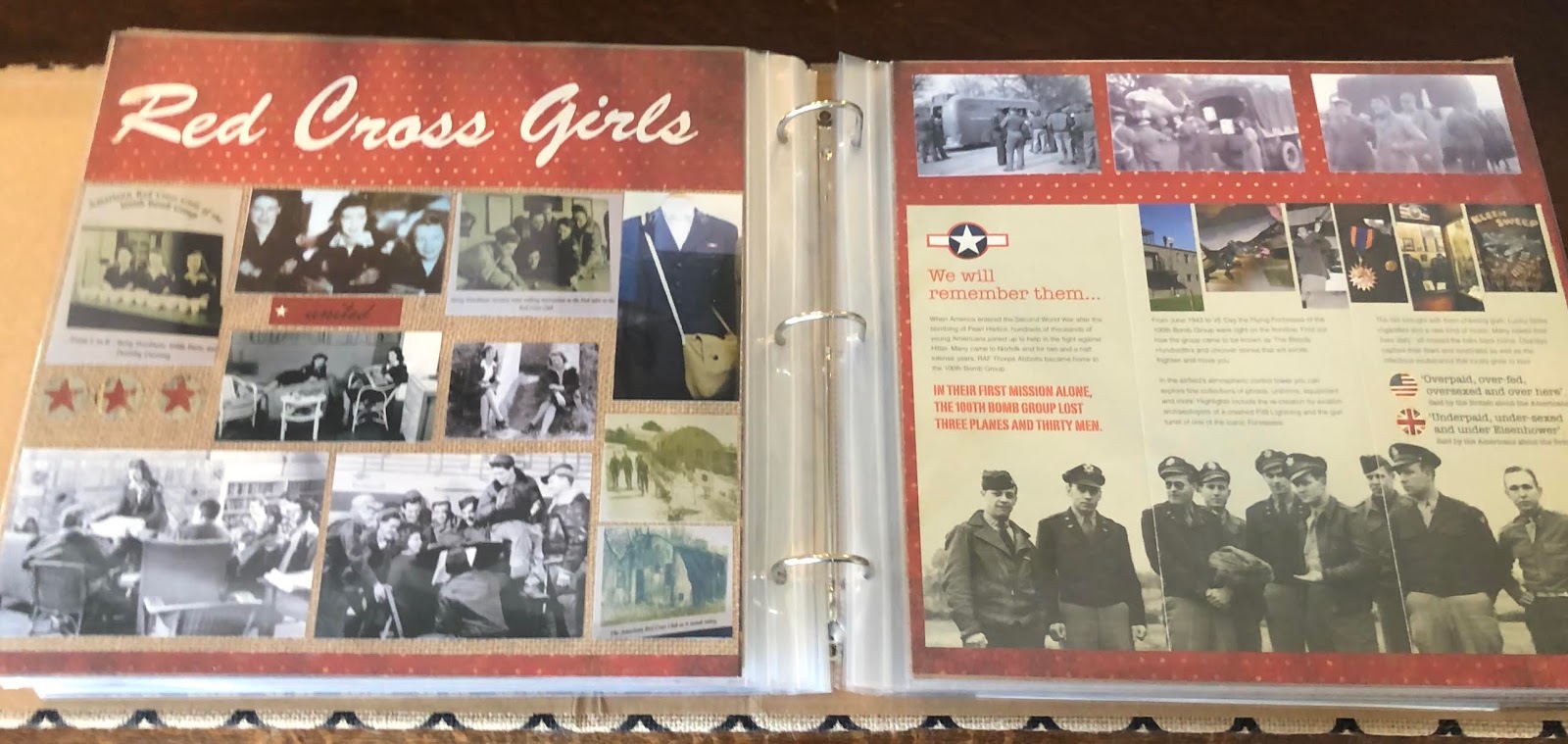
Then I remembered that I created a scrapbook of my first visit to the National WWII Museum in New Orleans in 2016 and my first WWII travel tour a few months later.  The National WWII Museum graciously allowed me the opportunity to read through their holdings from one former Red Cross Girl while I was there. All told, I spent the better part of 3 days at the museum and still had the sense that I was rushing through parts of it. If you've not visited it, I highly recommend adding it to your travel bucket list!

Their exhibits, arranged thematically around the different theaters of the war in many cases, are incredibly immersive. In the Road to Berlin exhibit, one moves from the earliest battle scenes in North Africa and Italy to the reconstructed Nissen hut from an American bomber base in England,
to the hedgerow country of Normandy, and then through the icy forested environs of the Battle of the Bulge,
and on finally through the bomb-torn rooftops and crumbling ruins of Germany in the waning months of the war in Europe.

            This photo gives you a flavor of the Road to Tokyo exhibit.
Complete with audio of jungle sounds and clips of period movies on the movie screens, this portion of the exhibit vividly evokes the war experience in the Southwest Pacific. From a scrapbooking standpoint, I enjoyed the opportunity to play with textured embellishments and texture-themed background papers in this album.

            “Masters of the Air” by Donald Miller is hands-down my favorite non-fiction work on the Eighth Air Force in WWII Europe, and I’m still thrilled that I splurged on the Miller-led tour that took us from London to the old bomber bases in East Anglia, lovingly restored to their former glory by local villagers over the last few decades. At each base, we had a chance to meet and mingle with older locals who were children during the war. Their stories were captivating, sometimes funny, sometimes poignant, but always related with a sense of awe and appreciation for the American boys who took the war to Germany years before D-Day and at such enormous cost.
            This bomber base was restored over the course of nearly 20 years, and I got a weird chill when I realized that I had attended a study abroad program not more than a few miles from this site in 1989, the year the local citizens began the restoration process.
Note the photos of original art that they were able to retain in the renovation. Living history is alive and well in England – at each bomber base, scores of re-enactors populated the base.
            The 100th Bomb Group at Thorpe Abbotts had a fantastic display of photos and memorabilia from the Red Cross Girls who had served at that location. One of the curators at the American Military Cemetery in Cambridge helped me locate the grave of a Red Cross Girl who died in a plane crash in Ireland late in the war.

            I enjoyed pulling out this album and sharing some of the highlights with you. Both these trips were a memorable first for me, and though I’m years behind with some of my scrapbooking projects, at least this one made it to the top of the heap.


Learn more about me and my writing on my website, and you can also find me on Facebook, Twitter, Pinterest, and Instagram. 

You can purchase my debut novel through the links below.
Amazon US  ~  Amazon UK  ~  Amazon CA  ~  Amazon AU  ~  Google ~ Nook  ~ Kobo

Tuesday, February 11, 2020

Stepping Outside the Comfort Zone by Eleri Grace


Sometimes the prompt for the monthly blog stumps me, and I’m forced to ruminate for a few days before settling on the best theme and angle. With this one, I immediately knew how I would approach it. You see, both my heroines and I know a bit about marching to the beat of a different drummer.
            The Red Cross recruited extraordinary and accomplished women for overseas assignments. Even though the Red Cross eventually deployed nearly 6,000 women overseas during WWII and the occupation years, they had exacting standards for potential recruits. Only one in six applicants was successful in the application and interview process. Marked not only by higher education and professional experience than most women of the era possessed, the women selected by the Red Cross also possessed some or all of the following attributes in some measure: poise, charm, good conversational skills, self-assurance, independence, ingenuity, adaptability, stamina, and creativity. Even in the early days of the war, the Red Cross knew they needed self-starters who could draw on a range of varied life experience to do unprecedented work.
The women who served as Red Cross Girls were exceptional and ahead of their time. One Red Cross Girl writing back to one of her training instructors from Europe said, “Some fellas think we’re brave, but we really don’t know enough to be scared. Some think we’d be better off at home, where a woman’s place used to be . . . about 200 years ago.” I think most of us probably find it astonishing that this 1940s woman viewed the women-as-only-homemakers model as an outdated norm. For some of these women then, the war presented another way to break free of the strictures imposed back home. Based on memoirs, many of them did go on to start or continue a successful career outside the home, whether they married or remained single. 


Their unique qualities didn’t shield them entirely from fear or from experiencing profound anxiety, stress, and war-weary despair. The same woman writing to her teacher noted: “Red Cross hasn’t done badly at all in picking personnel. Working here is what you’ve been all your life, but disciplined and worn down smooth, so that you smile when you’re dying.”
While they could request a transfer back to the United States after serving two years overseas, most of them felt a duty to continue on in their assignments. They had signed on for the duration after all, and they meant to see that through. Imagine being a young woman serving overseas near the front lines in France or Germany or on a bomber base in Guadalcanal or working on a train traversing Burma or Iran or at a cold and desolate station in Iceland. They had such courage, didn’t they?
So, I promised that I had something in common with my heroines, but I have to confess, I’m not sure I would have had the guts to do what they did. Sometimes when lying awake at night and thinking about a scene, I’m struck by the astonishing leap of faith it must have taken for them to board a troopship with destination unknown, duration unknown, dangers unknown, and even more by the courage it must have taken to stick it out.
But writing their stories is my own way of marching to the beat of a different drummer, for the industry professionals all said that WWII couldn’t sell as romance. Sure, there are WWII stories within Christian inspirational romance, and there are certainly plenty of mainstream historical fiction novels set during WWII (though the industry again says that too is glutted and out of fashion). I’m in uncharted waters to a large degree – though my novels are written with traditional romance novel beats and the expected HEA, they incorporate the serious historical research of mainstream historical fiction with a few hot and steamy interludes. Marketing has been a challenge, but reader enthusiasm tells me I’m on the right track. In any event, I’m living the maxim of writing what you love, and it is certainly making me happy.

Learn more about me and my writing on my website, and you can also find me on Facebook, Twitter, Pinterest, and Instagram. 


You can purchase my debut novel through the links below.
Amazon US  ~  Amazon UK  ~  Amazon CA  ~  Amazon AU  ~  Google ~ Nook  ~ Kobo

Tuesday, January 14, 2020


All in Good Fun?

By Eleri Grace


Even a war didn’t stop crew and passengers from participating in a naval tradition dating back centuries: the Crossing the Line ceremony. Tradition held that as a ship approached the equator, those who had made the crossing before, trusty “shellbacks,” initiate equator-crossing virgins or “tadpoles” (I replaced the actual term used for the initiates, which has unfortunate racist connotations, with tadpoles in my novel).  
Charged with entering the domain of King Neptune without permission, tadpoles must earn a shellback card that will give them permission to freely roam the Seven Seas by surviving a series of time-honored rituals. At a riotous pageant with participants sporting outrageous costumes that is held the night before the ceremony, King Neptune and Queen Amphitrite, along with a few other members of the “royal family,” are selected by popular vote.
In the next novel in my Clubmobile Girls series, my heroine Hadley joins her fellow tadpoles in navigating through the various proscribed ordeals of the Crossing the Line ceremony. All the Red Cross Girl memoirs from women who served in the Pacific theater that I found described participation in the ceremony. It was – and still is – permissible to decline to take part in the tradition. However, Red Cross Girls are nothing if not adventuresome and fun-loving. Though I did not find any photographs depicting Red Cross Girls, nurses, WACs or other women as participants, you might like to view this restored color footage of a WWII-era Crossing the Line ceremony from aboard the USS Knox. 
National Archives
An obstacle course typically features first in the ceremony, followed by various stops leading to the court of King Neptune. The first stop is often the royal photographer, whose camera might take a picture or might unpredictably shoot dye in your face. Next up is likely to be the royal doctor who might swab your throat with hot sauce. The royal dentist might rinse your mouth with a foul concoction of eggs, beer, and fish soup or something equally horrendous. The royal barber is then apt to shampoo your hair with some foul substance bearing an odor guaranteed to linger long after you’ve earned your shellback card, or, worse, cut or shave off your hair.
At some point amidst these stops, the tadpoles reach the Court of King Neptune and are sentenced for the crime of entering his domain without permission. Punishments are often comical and theatrical: playing childish games such as Ring around the Rosie for the amusement of the court or singing the national anthem backwards.
The end of the ceremony unvaryingly involves immersion and dunking the initiates, a conclusion rife with symbolism.
Collection of Imperial War Museum (from Wikimedia Commons)
After shellback cards are issued to all the initiates, a raucous party with free-flowing alcoholic beverages typically ensues.
            Farcical yes, but many of the standard elements in the ritual themselves “cross the line” into hazing. Today most navies officially proscribe observation of a weakened version of the Crossing the Line ceremony – an attempt to keep the fun without the bullying. Some cruise lines now offer a slapstick version of the ceremony to passengers. A writer who endured the ceremony in recent years wrote an insightful account of his experience, including photographs and his discussions about the origin and purpose of the ritual with a folklore expert.
          #FunNotFun might be an apt hashtag for Crossing the Line experiences.  


Learn more about me and my writing on my website, and you can also find me on Facebook, Twitter, Pinterest, and Instagram. 

You can purchase my debut novel through the links below.
Amazon US  ~  Amazon UK  ~  Amazon CA  ~  Amazon AU  ~  Google ~ Nook  ~ Kobo

Tuesday, December 10, 2019

May All Your Christmases be White

It may have been a white Christmas in 1944, but it certainly wasn't merry and bright.
This was especially true in western Europe, where the Germans had launched a last-ditch counter-offensive, now known as the Battle of the Bulge. Bitterly cold temperatures and heavy snow storms added to the miserable conditions endured by Allied forces.

(Library of Congress)
Our troops weren't the only Americans trapped by the wintry battle. Four Red Cross clubmobile crews were out serving units when the Germans attacked and were themselves trapped behind enemy lines. One Red Cross Girl, Peggy Henry, had been working at a Red Cross club in the resort town of Clervaux, Luxembourg and escaped under fire with a tank battle raging in the streets around her. In my novel Courage to be Counted, my heroine Vivian's experience is a dramatized composite of the harrowing ordeals of these Clubmobile crews and Peggy Henry's daring escape from Clervaux. Henry was later awarded the Bronze Star by President Truman for her bravery.

By Christmas Day 1944, most of these women were out of immediate danger. The women of Clubmobile Group B joined soldiers of the 1st Division to sing Christmas carols in the streets of Herve, Belgium on Christmas Eve, and though mixed with flashes of tracers and artillery fire in the sky, the brilliant stars brought a sense of peace and joy. The women of Clubmobile Group E later reported that they spent Christmas morning near Spa, Belgium diving into foxholes and serving doughnuts and coffee to the soldiers between alerts.


(National Archives)
It was Clubmobile Group F, however, who experienced the most dramatic Christmas of all, for they had been based at Bastogne in December and it was their Clubmobile crews who were most in peril at the time the Germans attacked. The crew of the Clubmobile named the Cheyenne were trapped at Vielsalm. One of Cheyenne's crew members, Jill Pitts, learned that her twin brother Jack had been killed in an early skirmish of the Battle of the Bulge, mere days after she had last seen him. Though she grieved for her brother, she had little choice but to carry on, especially given her own predicament. The town mayor of Vielsalm presented the women with an incendiary bomb: "To blow up your Clubmobile if the Boche should come." By the 21st, the US Army's 82nd Airborne had moved in, and the battle drew nearer. Early the next morning, the women were awakened and told they had a narrow window in which to escape. They loaded their Clubmobile with their Christmas gifts of nylons, perfume and food treats, bags of mail for the troops, and as much doughnut flour as they could carry. Following close behind a Jeep assigned to guide them out of Vielsalm, the women waved to the American soldiers lining their withdrawal route from this embattled village. In a bid to prevent German units from following, GIs threw up roadblocks as the Clubmobile roared past.


Still struggling to escape later that night, the Jeep guiding them ran into another vehicle. The women moved the injured men into the back of the Clubmobile, pushed the Jeep off the road, hitched the Jeep's trailer with its crucial supplies to the Clubmobile and drove on. An MP directed them around a tank battle, and they spent the night in an aid station. It took them until Christmas Eve to connect up with their main group at Charleville, France. They arrived in time to share some spiked Christmas punch and fruitcake with the other crews. While singing Christmas carols with the GIs that night, a German bomber dropped a bomb that shook the building. "When the ceiling didn't come down, they resumed singing."

After a day of serving crews and dodging bombs on Christmas Day, the crews of Clubmobile Group F received a hand-delivered message from their pals in the 101st Airborne, then mired in the Battle of Bastogne (immortalized in HBO's "Band of Brothers"): "Still here and pitching. Don't worry about us - we're doing okay. Thanks for the doughnut flour. We captured it from Jerry, and we're making pancakes from it every day. . . . See you soon - and have the doughnuts ready!"

Central Illinois WWII Stories, a video project of Illinois Public Media, created a stirring documentary tribute to Jill (Pitts) Knappenberger and her crewmates Phyllis and Helen and their dramatic escape from the siege at Vielsalm with the help of the 82nd Airborne.

Wishing all of you a happy holiday season, however and wherever you may celebrate!

You can learn more about me and my writing on my website, and you can also find me on Facebook, Twitter, Pinterest, and Instagram.


You can purchase my debut novel through the links below.
Amazon US  ~  Amazon UK  ~  Amazon CA  ~  Amazon AU  ~  Google ~ Nook  ~ Kobo